New Mini App Research Shows Why Security Testing and Privacy Validation Must Examine Runtime Behavior
Lazarus Alliance highlights a practical assurance model for embedded applications, secrets, third-party data flows, and

Press Release Disclaimer: This is a press release distributed through the XPR Media network. It has not been independently verified by our newsroom.
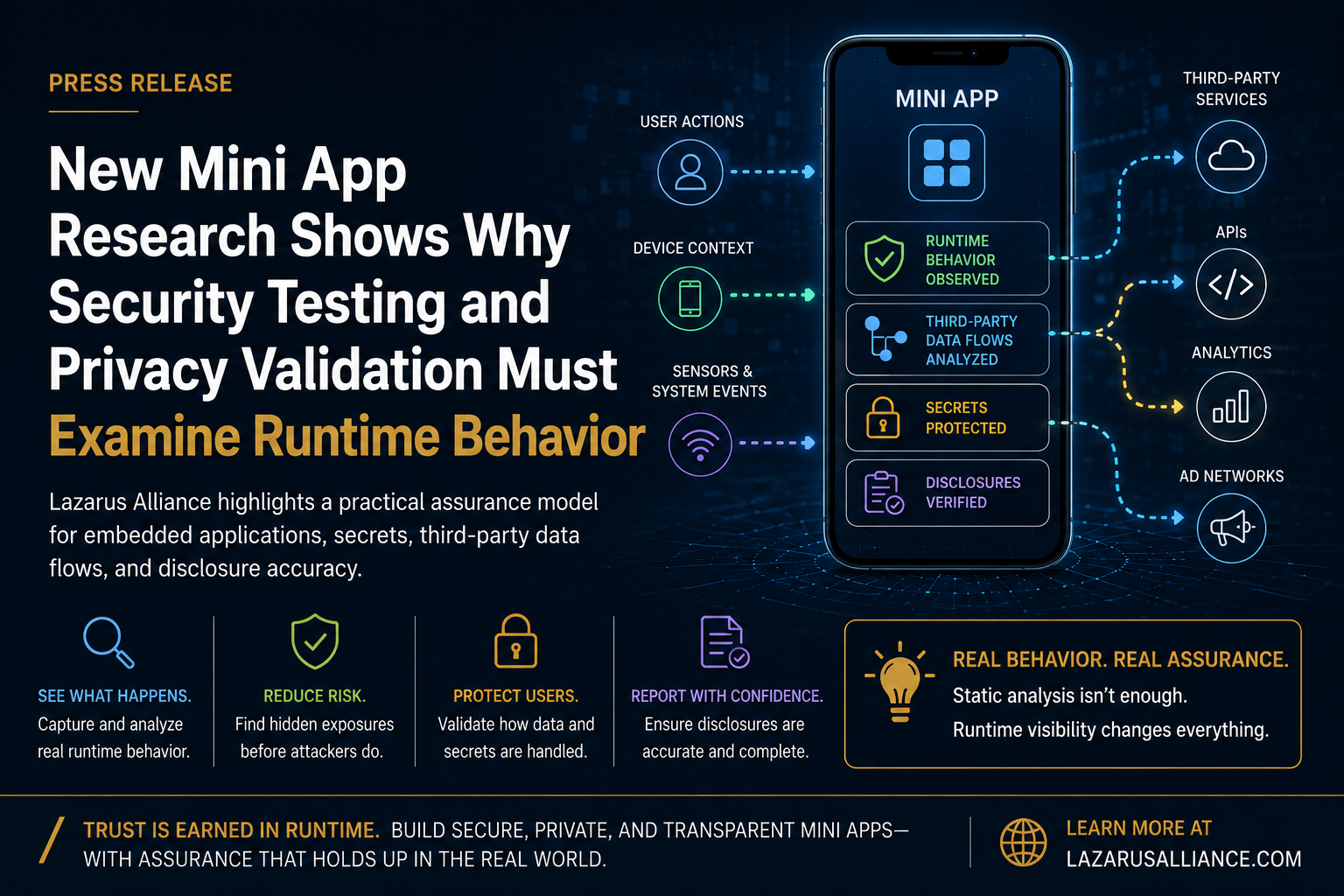

Lazarus Alliance highlights a practical assurance model for embedded applications, secrets, third-party data flows, and disclosure accuracy.
SCOTTSDALE, AZ, UNITED STATES, August 20, 2026 /EINPresswire.com/ — Two newly posted studies of Telegram Mini Apps report different forms of assurance failure in the same embedded-application ecosystem. A security study posted August 18 said researchers analyzed 37 qualifying Mini Apps and found security flaws in 30, including plaintext storage, recoverable encryption, or replayable tokens. A separate privacy study posted August 13 reported that 59.4% of 278 tested Mini Apps contacted at least one third party not disclosed by the applicable privacy policy. [Sources 1–2]
These are research findings with stated samples and methods, not universal measurements of every Mini App or embedded application. Their value for enterprise buyers is the testing lesson: documentation, architecture assumptions, and policy text should be checked against observable runtime behavior. [Sources 1–2; limitation stated by Lazarus Alliance]
For technical assurance, reviews should examine how applications store tokens, secrets, authentication state, and other sensitive values; how those values can be accessed; and whether client-side weaknesses can be combined with cross-site scripting, commodity malware, or local user-level access. Telegram’s own documentation describes a secure-storage API that uses the iOS Keychain or Android Keystore and is intended for tokens, secrets, and authentication state. [Sources 1 and 3]
For privacy assurance, teams should compare notices and data inventories with actual third-party connections, collection timing, consent behavior, and downstream processing. That requires coordination across security testing, privacy governance, development, vendor management, and legal review rather than treating penetration testing and privacy compliance as separate annual exercises.
SOURCES
• TENET: Telegram Mini App (in)security (Aug. 18, 2026)
• TeleGapper: Privacy Policies in Telegram Mini Apps (Aug. 13, 2026)
• Telegram Mini App secure-storage documentation
“Security and privacy cannot be validated by examining what an application claims it will do. Assurance comes from observing what it actually does at runtime. Mini apps operate inside complex ecosystems of APIs, third-party services, device capabilities, and data flows, creating risks that static analysis alone may never reveal. Organizations need to test real behavior, trace where sensitive information travels, protect secrets, and verify that privacy disclosures accurately reflect reality. That is the difference between assuming an application is trustworthy and having the evidence to prove it.” – Michael Peters, CEO & Founder, Lazarus Alliance
Lazarus Alliance can support scoped vulnerability and penetration testing, privacy control assessment, data-flow and evidence review, and governance advisory work. Any final release should state the tested scope and limitations and must not imply that the cited studies establish legal violations or platform-wide conclusions.
ABOUT LAZARUS ALLIANCE
Lazarus Alliance is a veteran-owned global provider of Proactive Cybersecurity®, specializing in cybersecurity audit and compliance, risk assessment and management, privacy audit and compliance, vulnerability and penetration testing, and IT policies and governance. Founded in 2000, the firm helps organizations attain, maintain, and demonstrate information security and compliance excellence across complex regulatory environments.
Lazarus Alliance is an authorized CMMC Third-Party Assessment Organization (C3PAO), an A2LA-accredited FedRAMP Third-Party Assessment Organization (3PAO), and a PCI DSS Qualified Security Assessor (QSA). Headquartered in Scottsdale, Arizona, Lazarus Alliance serves organizations ranging from startups to multinational enterprises with cybersecurity, privacy, risk, governance, and compliance expertise.
For more information, visit LazarusAlliance.com.
Michael Peters
Lazarus Alliance, Inc.
+1 8888967580
email us here
Visit us on social media:
LinkedIn
YouTube
X
About Lazarus Alliance
Legal Disclaimer:
EIN Presswire provides this news content “as is” without warranty of any kind. We do not accept any responsibility or liability
for the accuracy, content, images, videos, licenses, completeness, legality, or reliability of the information contained in this
article. If you have any complaints or copyright issues related to this article, kindly contact the author above.

Media gallery