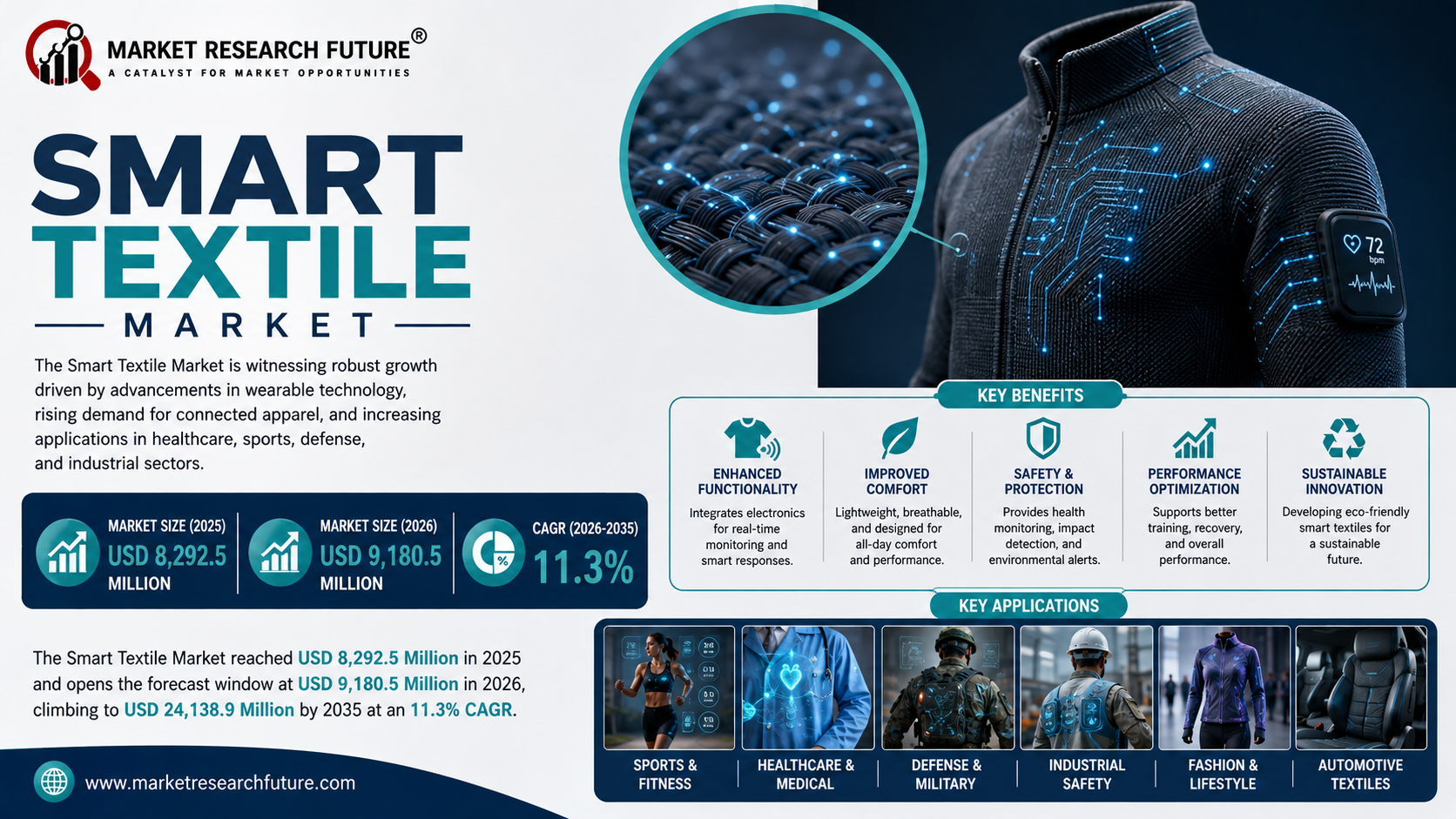
Smart Textile Market to Grow from USD 9,180.5 Million in 2026 to USD 24,138.9 Million by 2035 at 11.3% CAGR
North America accounted for a 30.1% share in 2025, led by U.S. federal and clinical procurement OR, UNITED STATES,

Press Release Disclaimer: This is a press release distributed through the XPR Media network. It has not been independently verified by our newsroom.


North America accounted for a 30.1% share in 2025, led by U.S. federal and clinical procurement
OR, UNITED STATES, September 2, 2026 /EINPresswire.com/ — The Smart Textile Market is evolving rapidly as textiles increasingly incorporate sensors, conductive materials, embedded electronics, energy-harvesting technologies, and connected systems. Smart fabrics are moving beyond conventional clothing to support sports performance, healthcare monitoring, military applications, automotive interiors, workplace safety, and other technology-driven uses.
According to Market Research Future, the global Smart Textile Market reached USD 8,292.5 million in 2025 and is projected to increase to USD 24,138.9 million by 2035, registering an 11.3% CAGR during 2026–2035. The market is expected to reach approximately USD 9,180.5 million in 2026, reflecting strong growth as wearable electronics and textile-integrated sensing technologies become more commercially viable.
Wearable Technology Accelerates Smart Textile Adoption
The growing integration of wearable technology is one of the major forces shaping the Smart Textile Market. Conventional wearable devices such as watches, chest straps, and clip-on sensors are increasingly being complemented by fabrics capable of collecting information directly from the body.
Smart garments can integrate conductive yarns, flexible sensors, and miniature electronic components into clothing. This enables continuous monitoring while maintaining the comfort and flexibility expected from conventional textiles.
The transition from rigid wearable devices toward textile-integrated electronics is creating opportunities for manufacturers to develop clothing capable of measuring movement, temperature, heart activity, pressure, and other physiological parameters.
Sports and Fitness Remain Major Application Areas
Sports and fitness represented approximately 29.9% of application demand in 2025, making it the largest application category in the Smart Textile Market.
Athletes and fitness consumers are increasingly interested in technologies capable of providing real-time information about physical performance. Smart shirts, compression garments, socks, and other connected clothing can capture movement and physiological data without requiring multiple external devices.
Sportswear companies are also using smart textile technologies to differentiate premium products. The combination of biometric monitoring, performance analytics, temperature regulation, and personalized feedback can increase the value of connected apparel.
As consumers become more familiar with wearable technology, smart textiles are expected to become increasingly integrated into everyday sports and fitness routines.
Healthcare Monitoring Creates Long-Term Opportunities
Healthcare is emerging as one of the most promising applications for smart textiles. Garments equipped with sensors can continuously monitor physiological indicators while allowing users to remain mobile.
According to MRFR, healthcare applications are expected to reach approximately USD 4,860.2 million by 2035.
Smart textile-based healthcare solutions can support remote patient monitoring, rehabilitation, elderly care, cardiac monitoring, and activity tracking.
One important advantage is comfort. Patients can potentially wear sensor-integrated garments for extended periods without relying on adhesive patches or rigid monitoring equipment.
The increasing adoption of remote healthcare and home-based monitoring is therefore expected to create significant demand for textile-based sensing solutions.
Military and Defense Demand Supports Innovation
Military and defense is another important growth area for smart textiles. Defense organizations are increasingly interested in clothing capable of monitoring soldier health, environmental conditions, movement, and fatigue.
Military and defense demand is projected to grow at an 11.1% CAGR through 2035.
Smart uniforms can potentially incorporate physiological sensors, communication systems, energy-harvesting components, and environmental monitoring technologies.
The ability to integrate multiple functions into a lightweight textile platform can reduce the need for separate equipment and improve mobility.
Defense procurement can also support commercialization because military customers are often willing to invest in technologies before they achieve mass-market pricing.
Request Free Sample Copy: https://www.marketresearchfuture.com/sample_request/5477
Passive Smart Textiles Hold a Significant Share
By type, Passive Smart Textiles accounted for approximately 41.5% of market share in 2025. These materials can respond to environmental conditions or provide enhanced functionality without requiring complex active electronic systems.
Applications include thermoregulating fabrics, moisture-management materials, protective textiles, and other functional clothing.
Active smart textiles incorporate sensors or other components that respond dynamically to external conditions. These products are becoming increasingly important as textile manufacturers integrate electronics and connectivity.
Ultra-smart textiles represent the most technologically advanced category and are projected to expand at an 11.8% CAGR through 2035.
Sensing Technology Drives Market Development
Sensing is a central functionality within smart textiles. Textile-integrated sensors can detect movement, pressure, temperature, strain, moisture, and physiological signals.
The development of flexible and stretchable sensors is particularly important because conventional electronic components can restrict the movement and comfort of clothing.
Advances in conductive yarns and printable electronics are helping manufacturers integrate sensing functions directly into fabrics.
The result is a gradual transition from electronics attached to garments toward electronics embedded within the textile structure itself.
Energy Harvesting Creates New Possibilities
Energy harvesting is becoming increasingly important as smart textiles require power for sensors and electronic components. Conventional batteries add weight and require periodic charging, limiting the convenience of connected clothing.
Smart textiles can potentially harvest energy from body movement, heat, light, or other environmental sources.
Thermoelectric technologies can use temperature differences between the body and surrounding environment to generate electricity. Kinetic systems can convert movement into usable energy.
These technologies could eventually reduce dependence on conventional batteries and enable more autonomous smart garments.
Flexible Electronics Improve Textile Integration
Miniaturization of electronic components is transforming the Smart Textile Market. Smaller sensors, flexible circuits, stretchable interconnects, and conductive fibers enable manufacturers to integrate electronics without significantly compromising garment comfort.
The development of flexible hybrid electronics is particularly important because textile products must withstand bending, stretching, and repeated movement.
Wash durability remains a major technical challenge. Smart textile manufacturers must ensure that electronic components remain functional after repeated laundering and everyday use.
Improving durability will be essential for moving smart textiles from specialized applications into mass-market clothing.
Sustainability Becomes a Competitive Priority
Sustainability is increasingly influencing the development of smart textiles. Textile manufacturers face growing pressure to reduce waste, improve material efficiency, and develop more environmentally responsible products.
However, embedding electronics into fabrics creates new recycling challenges. Conductive materials, batteries, and electronic components can make garments more difficult to process through conventional textile recycling systems.
Manufacturers are therefore exploring modular electronics, removable components, recyclable conductive materials, and disassembly-friendly designs.
Sustainable smart textiles could become an important differentiator as environmental regulations and consumer expectations continue to evolve.
Purchase Now: https://www.marketresearchfuture.com/checkout?currency=one_user-USD&report_id=5477
Sports Performance Drives Consumer Adoption
Consumer demand for personalized sports-performance information is creating opportunities for smart clothing manufacturers. Connected garments can potentially provide detailed information about posture, movement, muscle activity, heart rate, and other performance indicators.
Running, cycling, fitness training, and professional sports represent particularly attractive areas.
Smart textiles can also complement existing wearable devices rather than replace them. For example, a garment can collect detailed body measurements while a smartwatch provides user-facing information.
This combination can create broader wearable ecosystems and new opportunities for apparel and technology companies.
Automotive Applications Create Emerging Opportunities
Automotive manufacturers are increasingly exploring smart textile technologies for vehicle interiors. Textile-integrated pressure and occupancy sensors can potentially monitor passenger position, posture, and interaction with seats.
Smart fabrics can also contribute to heating, cooling, lighting, and personalized interior experiences.
As vehicles become more connected and autonomous, the interior environment is becoming increasingly important. Textile-based sensing provides an opportunity to gather information without relying exclusively on cameras or rigid sensors.
Automotive applications could therefore become an important growth opportunity for smart textile manufacturers during the forecast period.
Worker Safety Expands Industrial Demand
Industrial employers are increasingly interested in connected workwear that can monitor environmental and physiological conditions.
Smart garments can potentially detect excessive heat exposure, fatigue, posture, movement, or hazardous environmental conditions.
This is particularly relevant for construction, mining, manufacturing, logistics, and other industries where employees work in physically demanding environments.
The ability to provide continuous monitoring could help companies improve worker safety while generating valuable operational data.
North America Maintains Market Leadership
North America accounted for approximately 30.1% of the Smart Textile Market in 2025, making it the leading regional market. Strong demand from defense, healthcare, sports, and technology industries supports the region’s position.
The United States is particularly important because of its advanced technology ecosystem and significant investment in wearable electronics.
The region also benefits from collaboration between textile manufacturers, technology companies, healthcare providers, defense organizations, and research institutions.
These partnerships are helping accelerate the transition of smart textile technologies from research projects to commercial applications.
Asia-Pacific Records the Fastest Growth
Asia-Pacific is projected to be the fastest-growing regional market, expanding at a 12.9% CAGR through 2035.
China, India, Japan, and South Korea are important contributors to regional growth. The region benefits from a large textile manufacturing base, expanding electronics industries, growing consumer markets, and increasing government support for advanced textile technologies.
India’s National Technical Textiles Mission is also supporting specialty fiber development and smart textile manufacturing capabilities.
The combination of textile production expertise and electronics manufacturing creates strong opportunities for regional supply-chain development.
Europe Focuses on Sustainable Smart Textiles
Europe is another important market, with the region generating approximately USD 2,189.2 million in 2025.
European manufacturers are placing strong emphasis on sustainability, circularity, product traceability, and environmentally responsible textile production.
Digital product identification and sustainability regulations are encouraging brands to consider technologies that can combine product authentication, traceability, and smart functionality.
The region’s focus on sustainable materials and circular textile systems is expected to influence the design of next-generation smart garments.
Challenges Facing the Smart Textile Market
Despite strong growth potential, several challenges could affect market expansion. Wash durability remains one of the most significant technical obstacles because electronic components must withstand repeated laundering.
High production costs are another challenge. Smart garments can require conductive yarns, specialized sensors, electronic modules, and additional assembly processes.
The absence of universal testing and interoperability standards can also make it difficult for buyers to compare competing products.
Data privacy and medical-device regulations create additional complexity when smart textiles collect sensitive physiological information.
Addressing these challenges will be essential for broader commercial adoption.
Report Summary: https://www.marketresearchfuture.com/reports/smart-textile-market-5477
Competitive Landscape
The Smart Textile Market includes major companies such as DuPont, Toray Industries, Google, VF Corporation, Apple, and Jabil.
Competition is increasingly focused on sensor integration, material development, wearable electronics, connectivity, durability, and data services.
Companies are also exploring partnerships between textile manufacturers and technology providers to combine expertise in fabrics, electronics, software, and consumer products.
As the market matures, recurring software and analytics services could become increasingly important alongside smart textile hardware.
Related Report
Textile Fabrics Market https://www.marketresearchfuture.com/reports/textile-fabrics-market-8231
organic textile market https://www.marketresearchfuture.com/reports/organic-textile-market-23225
bioplastic textile market https://www.marketresearchfuture.com/reports/bioplastic-textile-market-31263
smart interactive textile market https://www.marketresearchfuture.com/reports/smart-interactive-textile-market-30818
silk textile market https://www.marketresearchfuture.com/reports/silk-textile-market-32563
Textile Dyes Market https://www.marketresearchfuture.com/reports/textile-dyes-market-3111
Market Research Future
Market Research Future
+1 855-661-4441
email us here
Legal Disclaimer:
EIN Presswire provides this news content “as is” without warranty of any kind. We do not accept any responsibility or liability
for the accuracy, content, images, videos, licenses, completeness, legality, or reliability of the information contained in this
article. If you have any complaints or copyright issues related to this article, kindly contact the author above.

Media gallery