Boke Foundation Highlights Early Cultivation of Green Talent at the Beijing Green Development Forum 2026
Developing green talent means looking beyond today's needs — it's about building the talent pipeline our future economy

Press Release Disclaimer: This is a press release distributed through the XPR Media network. It has not been independently verified by our newsroom.

BEIJING, CHINA, September 22, 2026 /EINPresswire.com/ — As the global green transition continues to gather pace, talent has become one of the key drivers of green development. How to expand the green talent pipeline, strengthen green skills, and build a more resilient talent pool was therefore a major focus of the 2026 Beijing Green Development Forum.
Held on 17–18 September in Beijing Municipal Administrative Center, the 2026 Beijing Green Development Forum convened more than 100 participants, including United Nations officials, Nobel laureates, diplomatic envoys to China, representatives of international organizations, academics, experts, and senior executives from multinational companies. Under the theme “Green Empowerment, Low-Carbon Coexistence,” the forum featured in-depth discussions on the green economy, green technology, green finance, and green talent.
As one of the forum’s key parallel events, the Green Talent Forum and 2026 Global Talent Summit focused on “Green Talent Competitiveness in the AI Era: Green Skills and Green Leadership.” Representatives from international organizations, think tanks, businesses, universities, and civil society organizations came together to explore green talent development, skills transition, and cross-sector collaboration.
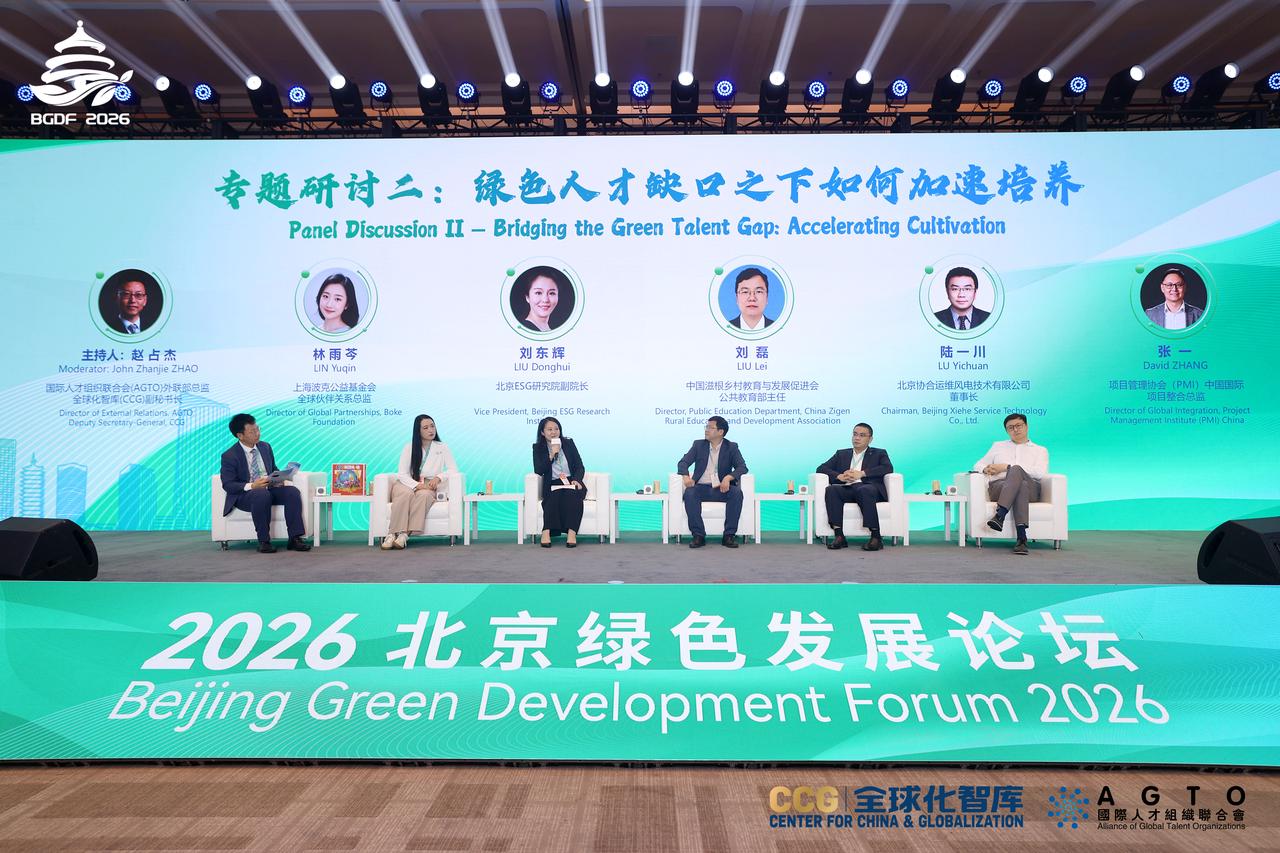
Panel discussion on accelerating green talent development at the 2026 Beijing Green Development Forum.
Boke Foundation was invited to take part in the forum. During the roundtable discussion on “Accelerating Green Talent Development,” LIN Yuqin, Director of Global Partnerships at Boke Foundation, drew on the foundation’s long-term work in sustainability education for young people. She argued that green talent development should be viewed through the longer-term lens of building a future talent pipeline. Current discussions about green talent, she noted, often focus on higher education, vocational training, and industry-specific skills. Yet if the goal is to build a robust long-term talent pool, cultivation can begin much earlier.
This philosophy also underpins SDG Hero, Boke Foundation’s sustainability education initiative. Through game-based learning, the initiative translates the United Nations Sustainable Development Goals into educational content that young people can understand, engage with, and co-create. It encourages them to move beyond acquiring knowledge to identifying problems, thinking independently, and taking practical action. To date, SDG Hero has reached more than 60 countries and regions and engaged over 100,000 young people. Across diverse contexts, participants explore and co-create around issues including climate change, biodiversity, public health, and desertification, with some of their ideas subsequently extending into schools and local communities. In a recent example from Mongolia, middle-school students participating in the initiative designed their own board game around desertification and used it to help peers and community members better understand the issue.
LIN Yuqin shares Boke Foundation’s approach to nurturing green talent from an early age.
These experiences have further reinforced Boke Foundation’s belief that green talent development does not need to begin only when young people enter university or the green economy. Awareness of environmental and social challenges, the habit of independent thinking, a capacity for innovation, and the ability to turn ideas into action can all be nurtured much earlier in life.
Green talent development should therefore address not only today’s demand for green skills but also the need to build a long-term talent pipeline. By starting earlier and extending learning opportunities to a wider group of young people, society can enable more of them to engage with real sustainability challenges at an early age—laying the foundation for a broader, more diverse, and highly capable green workforce in the future.
This process also depends on collaboration across sectors. Through its international work, Boke Foundation has gradually developed a partnership network involving governments, international organizations, schools and communities, civil society organizations, and businesses. Each plays a distinct role, from policy support and platform-building to educational delivery, professional expertise, and resource coordination.
From workforce skills development to early learning for young people, a more complete green talent pipeline is beginning to take shape. For philanthropic organizations, a distinctive contribution may lie at the very start of that pipeline: creating more opportunities for young people to recognize real-world challenges early, engage with them directly, and develop through practice the foundational capabilities they will need as the green talent of the future.
SDG Hero
BOKE Foundation
+1 216-265-1133
infogy@boke.com
Legal Disclaimer:
EIN Presswire provides this news content “as is” without warranty of any kind. We do not accept any responsibility or liability
for the accuracy, content, images, videos, licenses, completeness, legality, or reliability of the information contained in this
article. If you have any complaints or copyright issues related to this article, kindly contact the author above.

Media gallery