Digital Pathology Market to reach USD 5.23 Billion by 2035 at 10.4% CAGR
Digital Pathology Market to Surge from USD 1.96 Billion in 2025 to USD 5.23 Billion by 2035— Pathologist Shortage,

Press Release Disclaimer: This is a press release distributed through the XPR Media network. It has not been independently verified by our newsroom.

Digital Pathology Market to Surge from USD 1.96 Billion in 2025 to USD 5.23 Billion by 2035— Pathologist Shortage, Regulatory Clearance for Primary Diagnosis
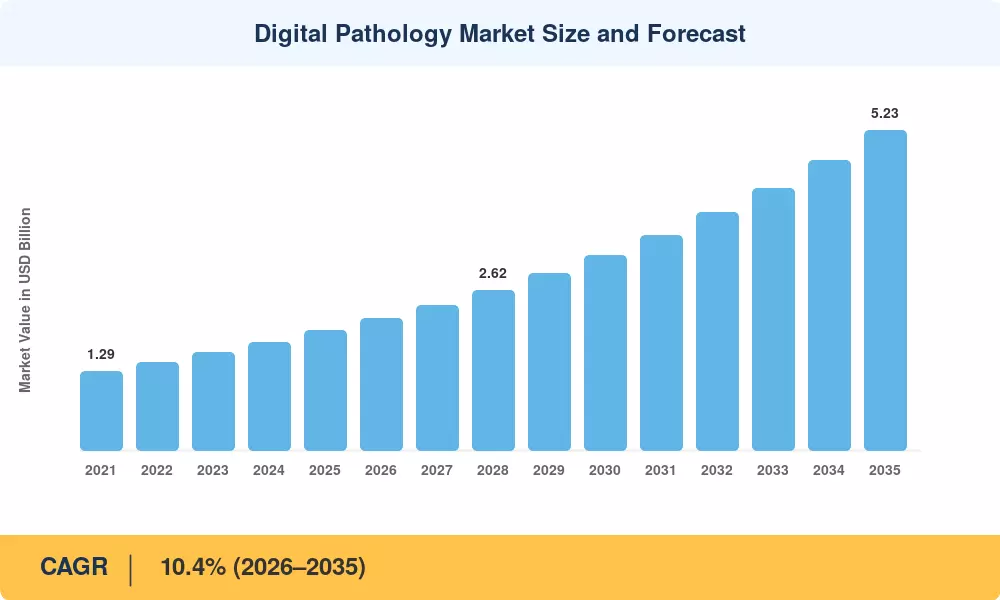
NY, CA, UNITED STATES, September 22, 2026 /EINPresswire.com/ — As per Market Research Future, the global Digital Pathology Market size is projected to reach USD 5.23 Billion by 2035 from USD 1.96 Billion in 2025, at a CAGR of 10.4% during the forecast period 2026–2035. The market base was estimated at USD 1.96 Billion in 2025, with the first year of the forecast period (2026) valued at USD 2.15 Billion.
The 10.4% CAGR is propelled by three converging forces: pathologist shortage and workload compression, with only 3% of United Kingdom histopathology departments having enough staff to meet clinical demand and United States residency output staying roughly flat since 2010 even as biopsy volumes climbed; regulatory clearance for primary diagnosis, with regulators clearing several whole-slide imaging platforms for primary diagnosis rather than adjunctive review, removing the compliance ambiguity that stalled procurement for a decade; and reimbursement turning telepathology into revenue, with dedicated procedure codes for digitised specimen consultation beginning to compensate remote review in the United States.
Global research funding and technology investment are amplifying this momentum. The National Institutes of Health committed USD 150 million through its Bridge2AI program in 2025 to validate pathology algorithms against curated, bias-audited datasets. Danaher, Roche and Philips have each redirected material R&D budget toward this transition, and vendors now bundle software subscriptions with hardware rather than selling one-time capital equipment. North America holds 44.5% of 2025 revenue, supported by dedicated CPT reimbursement codes and the deepest installed scanner base, while Asia-Pacific grows fastest at a 12.0% CAGR as China and India digitise tertiary hospital networks. Europe ranks second with USD 0.54 billion in 2025, driven by national screening programmes and centralised pathology hubs in the Nordics and the United Kingdom.
Request A Free Sample:
https://www.marketresearchfuture.com/sample_request/1955
Key Market Trends & Growth Drivers
Pathologist Shortage Forces Structural Change
Diagnostic volume is rising while the workforce shrinks. The Royal College of Pathologists reported that only 3% of United Kingdom histopathology departments had enough staff to meet clinical demand, with vacancy rates near 25% across the network. United States residency output has stayed roughly flat since 2010 even as biopsy volumes climbed. Digitisation is the only lever that redistributes work without adding headcount, letting a subspecialist in one city sign out cases queued in another. That workload arbitrage is the single strongest demand signal in the Digital Pathology Market.
Regulatory Clearance Removed the Procurement Blocker
Before primary-diagnosis clearance, hospitals could digitise but still had to keep a microscope in the loop, which destroyed the business case. Successive clearances for whole-slide imaging systems changed that calculus outright. Chief pathologists can now retire glass review for cleared indications, and capital committees will fund a project that eliminates duplicated effort rather than adding a parallel process.
Reimbursement Turned Telepathology Into Revenue
Dedicated procedure codes for digitised specimen consultation began compensating remote review in the United States, converting a cost centre into a billable service line. Reference laboratories responded quickly, marketing subspecialty second opinions to community hospitals that cannot justify a resident expert. The effect is measurable in scanner utilisation, which vendors report has risen from roughly 40 slides per hour to sustained multi-shift operation at high-volume sites.
Pharmaceutical Sponsors Demand Image-Based Endpoints
Trial sponsors increasingly write quantitative image endpoints into protocols because manual scoring introduces inter-reader variance that inflates required sample sizes. Companion diagnostic submissions now routinely include algorithm-derived scoring, and contract research organisations have built dedicated digital reading facilities to service them. This channel carries higher software attach rates than hospital deployments and is the primary reason pharmaceutical end users outgrow clinical laboratories.
Ask for Customization:
https://www.marketresearchfuture.com/ask_for_customize/1955
Market Segment Insights
BY PRODUCT
Whole Slide Imaging Scanners: Largest segment with 40.5% revenue share in 2025 , driven by primary-diagnosis clearance and multi-shift throughput needs. Scanners still anchor the market because nothing downstream exists without a digitised slide.
Image Analysis & AI Software: Fastest-growing segment at 10.9% CAGR (2026–2035) , driven by quantitative biomarker scoring and triage workloads. AI pathology image analysis packages priced per case rather than per seat convert clinical volume directly into vendor revenue.
Information Management Systems: Significant segment at USD 0.24 billion in 2025, driven by LIS integration and case routing requirements.
Storage & Communication Systems: Growing at 9.8% CAGR (2026–2035) , driven by retention mandates and archive migration.
BY IMAGING TECHNIQUE
Brightfield: Largest segment with 79.1% revenue share in 2025 , driven by routine H&E and immunohistochemistry diagnostics. Routine diagnostics run on brightfield and will for the foreseeable future—it is fast, cheap and matches the stains pathologists already trust.
Fluorescence: Fastest-growing technique at 11.3% CAGR (2026–2035) , driven by multiplex panels and spatial biology research. Instrument costs are two to three times brightfield equivalents, so revenue growth outpaces unit growth substantially.
BY APPLICATION
Disease Diagnosis: Largest segment with 52.7% revenue share in 2025 , driven by oncology case volume and turnaround pressure. Diagnosis dominates because it is where the specimen volume lives, and oncology alone accounts for the majority of digitised cases.
Drug Discovery & Development: Significant segment at USD 0.36 billion in 2025, driven by image-based trial endpoints and companion diagnostics.
Telepathology & Consultation: Fastest-growing application at 11.1% CAGR (2026–2035) , driven by reimbursed remote subspecialty second opinions.
BY END USER
Hospitals & Reference Laboratories: Largest segment with 41.1% revenue share in 2025 , driven by workload consolidation and subspecialty coverage.
Pharmaceutical & Biotechnology Companies & CROs: Fastest-growing end user at 11.2% CAGR (2026–2035) , driven by regulatory demand for quantitative endpoints. Hospitals buy the most units; pharmaceutical sponsors buy the most software per user.
Academic & Research Institutes: Significant segment at USD 0.31 billion in 2025, driven by grant-funded spatial biology programmes.
Read Detailed Insights:
https://www.marketresearchfuture.com/reports/digital-pathology-market-1955
Regional Outlook
North America — Dominant Market (~44.5% Share, 2025)
United States: Holds 82.4% of regional revenue , driven by reimbursement codes and cleared primary-diagnosis platforms. United States demand rests on a reimbursement foundation no other country matches.
Canada: Contributes USD 0.09 billion, driven by provincial health authority consolidation of laboratory services.
Mexico: Fastest-growing in the region at 11.4% CAGR (2026–2035) , driven by private hospital-group modernisation.
Europe — Second Largest (USD 0.54 Billion, 2025)
Germany: Holds 22.6% of regional revenue , driven by university hospital networks and pharmaceutical R&D proximity.
United Kingdom: Contributes USD 0.10 billion, driven by national pathology network consolidation and screening backlogs.
France: Fastest-growing in the region at 10.9% CAGR (2026–2035) , driven by regional cancer centre digitisation programmes.
Italy: Holds 9.4% of regional revenue , driven by public tender cycles for laboratory modernisation.
Spain: Contributes USD 0.04 billion, driven by autonomous community health service pilots.
Nordic Countries: Growing at 11.5% CAGR (2026–2035) , driven by Sectra-anchored regional archives and high digital maturity.
Russia: Holds 3.1% of regional revenue , driven by federal oncology centre equipment renewal.
Rest of Europe: Contributes USD 0.06 billion, driven by cross-border teleconsultation among smaller states.
Asia-Pacific — Fastest-Growing Region (12.0% CAGR, 2026–2035)
China: Holds 30.2% of regional revenue , driven by tertiary hospital grading requirements and domestic scanner supply.
India: Fastest-growing in the region at 13.4% CAGR (2026–2035) , driven by diagnostic chain expansion and severe pathologist scarcity. India has roughly one pathologist for every 65,000 people.
Japan: Contributes USD 0.09 billion, driven by ageing population and high biopsy volumes.
South Korea: Holds 9.6% of regional revenue , driven by national cancer screening and hospital IT maturity.
ASEAN: Growing at 12.6% CAGR (2026–2035) , driven by cross-border teleconsultation and medical tourism hubs.
South America — Growing Presence (USD 0.08 Billion, 2025)
Brazil: Holds 54.8% of regional revenue , driven by private laboratory chains and oncology centre investment.
Argentina: Contributes USD 0.02 billion, driven by university hospital research programmes.
Middle East & Africa — Emerging Opportunity (3.8% Share, 2025)
Saudi Arabia: Holds 27.4% of regional revenue , driven by health sector transformation programme funding.
UAE: Fastest-growing in the region at 12.8% CAGR (2026–2035) , driven by medical tourism and greenfield hospital builds.
South Africa: Contributes USD 0.01 billion, driven by national laboratory service pilot deployments.
Egypt: Holds 8.9% of regional revenue , driven by university hospital and oncology institute upgrades.
Competitive Landscape and Recent Developments
Concentration in the Digital Pathology Market is moderate, with the top five suppliers together holding roughly 48–55% of revenue. Hardware is consolidating around four scanner platforms; software remains genuinely fragmented, with more than 40 credible vendors selling cleared or research-use algorithms.
KEY COMPANIES AND RECENT MILESTONES
Leica Biosystems (Danaher) (March 2024): Expanded its scanner-agnostic image management platform with third-party algorithm hosting, signalling a shift from closed hardware to marketplace economics. Broadest installed base. Estimated ~14–18% revenue share.
Roche Diagnostics (September 2024): Extended its digital pathology software into companion diagnostic workflows, linking algorithm scoring to therapy selection decisions. Ties digitisation to its own IHC assay and CDx franchise. Estimated ~11–15% revenue share.
Koninklijke Philips: Early primary-diagnosis clearance with enterprise imaging integration. Estimated ~8–11% revenue share.
Hamamatsu Photonics: Optics-led differentiation with strong Japanese and research base. Estimated ~6–9% revenue share.
Sectra AB (June 2024): Signed multi-hospital enterprise imaging agreements in the Nordics and United Kingdom that place pathology alongside radiology in a single archive. Estimated ~4–6% revenue share.
Paige (November 2023): Released clinical-grade foundation models trained on multi-institution slide archives, reframing the competitive basis from task-specific tools to general-purpose backbones. Estimated ~1–3% revenue share.
Ibex Medical Analytics (May 2025): Announced expanded European deployments of its quality-control and detection applications across private laboratory networks. Estimated ~1–2% revenue share.
Recent Industry Developments:
U.S. Food and Drug Administration (January 2024): Granted additional clearances covering whole-slide imaging for primary diagnostic use, broadening the range of validated scanner-display combinations.
National Institutes of Health (February 2025): Allocated USD 150 million under Bridge2AI to build ethically sourced, bias-audited datasets for pathology algorithm validation.
Future Outlook: 2026–2035
The Digital Pathology Market is projected to reach USD 5.23 Billion by 2035, growing at a CAGR of 10.4%, driven by pathologist shortage, regulatory clearance, and reimbursement.
New opportunities lie in:
Subscription and Per-Slide Pricing Models: By pricing by scanned slide rather than by instrument, vendors match their revenue to laboratory throughput and remove the capital hurdle altogether.
Archive Monetisation and Real-World Evidence: Curated, de-identified image archives linked to outcomes data are becoming a licensable asset for drug discovery teams.
Emerging-Market Hub-and-Spoke Networks: In countries with less than one pathologist per 500,000 population, centralized scanning hubs for spoke facilities mean that a single national reading center can cover an entire province.
Spatial Biology Convergence: Adding proteomic and transcriptomic layers to morphology pushes scanner specs beyond brightfield and increases average selling prices.
Algorithms Move From Triage to Autonomy: The next decade shifts specific low-complexity, high-volume tasks toward conditional autonomy under defined confidence thresholds.
Platform Economics Displace Hardware Margins: Value migrates to the archive, the viewer and the algorithm marketplace layered above them, and vendors controlling the image management platform capture recurring revenue.
By 2035, the Digital Pathology Market is expected to achieve substantial growth, reflecting the transformation of pathology from glass slides to digital archives and AI-assisted diagnosis.
More Related Research Insights:
https://www.marketresearchfuture.com/ja/reports/organ-on-chip-market-8498
https://www.marketresearchfuture.com/de/reports/organ-on-chip-market-8498
https://www.marketresearchfuture.com/es/reports/organ-on-chip-market-8498
https://www.marketresearchfuture.com/zh-cn/reports/organ-on-chip-market-8498
https://www.marketresearchfuture.com/ko/reports/organ-on-chip-market-8498
https://www.marketresearchfuture.com/fr/reports/nurse-call-system-market-5631
https://www.marketresearchfuture.com/ja/reports/nurse-call-system-market-5631
https://www.marketresearchfuture.com/de/reports/nurse-call-system-market-5631
https://www.marketresearchfuture.com/es/reports/nurse-call-system-market-5631
https://www.marketresearchfuture.com/zh-cn/reports/nurse-call-system-market-5631
https://www.marketresearchfuture.com/ko/reports/nurse-call-system-market-5631
https://www.marketresearchfuture.com/fr/reports/next-generation-sequencing-market-6354
https://www.marketresearchfuture.com/ja/reports/next-generation-sequencing-market-6354
https://www.marketresearchfuture.com/de/reports/next-generation-sequencing-market-6354
https://www.marketresearchfuture.com/fr/reports/neurorehabilitation-devices-market-2210
Market Research Future
Market Research Future
+1 855-661-4441
email us here
Legal Disclaimer:
EIN Presswire provides this news content “as is” without warranty of any kind. We do not accept any responsibility or liability
for the accuracy, content, images, videos, licenses, completeness, legality, or reliability of the information contained in this
article. If you have any complaints or copyright issues related to this article, kindly contact the author above.

Media gallery