Biobanking Market to reach USD 85.77 Billion by 2035 at 5.27% CAGR
Biobanking Market to Surge from USD 51.32 Billion in 2025 to USD 85.77 Bn by 2035- Precision Medicine Rewriting the

Press Release Disclaimer: This is a press release distributed through the XPR Media network. It has not been independently verified by our newsroom.

Biobanking Market to Surge from USD 51.32 Billion in 2025 to USD 85.77 Bn by 2035- Precision Medicine Rewriting the Specification, Donor-Eligibility Guidance
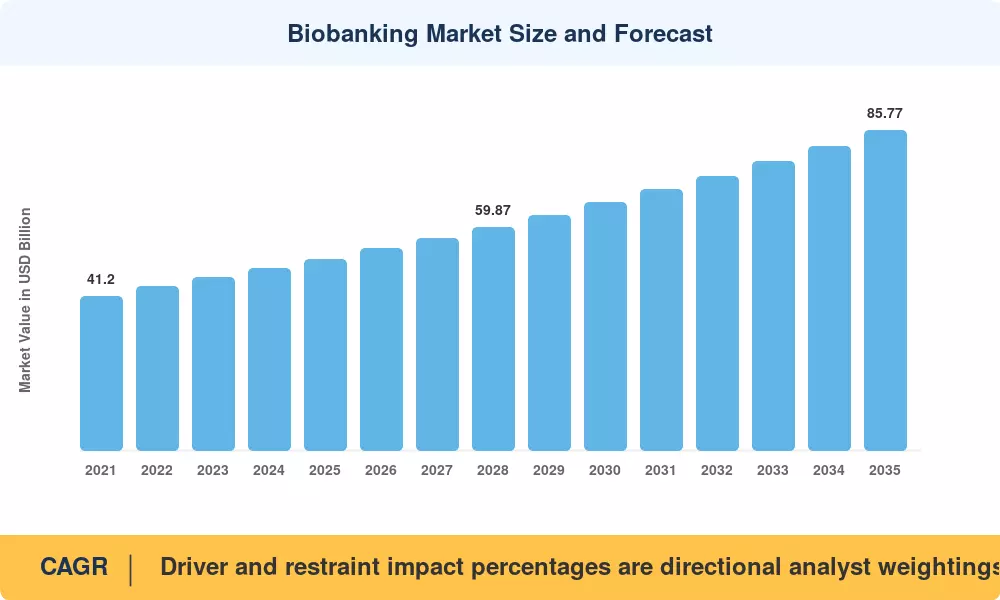
NY, CA, UNITED STATES, September 22, 2026 /EINPresswire.com/ — As per Market Research Future, the global Biobanking Market size is projected to reach USD 85.77 Billion by 2035 from USD 51.32 Billion in 2025, at a CAGR of 5.27% during the forecast period 2025–2035. The market base was estimated at USD 51.32 Billion in 2025, with the first year of the forecast period (2026) valued at USD 54.02 Billion.
The 5.27% CAGR is propelled by three converging forces: precision medicine and multi-omics programme expansion, with cohort programmes now demanding annotated, consented, multi-omics-ready specimens rather than volume, lifting revenue per sample by an estimated 18–22% versus conventional archival storage; regulatory clarity on donor eligibility and consent, with the FDA’s January 2025 draft guidance tightening screening and testing expectations for human cells, tissues, and cellular products and giving hospital repositories a defensible compliance template; and hospital cord-blood and cell-therapy service uptake, with more than 2,900 cell and gene therapy trials active globally in 2025 and each Phase III programme typically requiring validated cryopreservation at multiple sites.
Global research funding and infrastructure investment are amplifying this momentum. Sustained appropriations to the NIH All of Us programme—cumulatively above USD 3.4 billion since inception—keep population-scale cohort collection funded through the decade. BBMRI-ERIC’s federated infrastructure now connects over 600 European facilities under harmonized quality standards, and Azenta, Hamilton, and Thermo Fisher each committed nine-figure capital programs to automation lines between 2023 and 2025. North America retains 33.4% of 2025 revenue, driven by the demand for commercial cell therapy, NCI, and NIH. As China’s National GeneBank and India’s Department of Biotechnology cohorts expand, the Asia-Pacific region will compound at a rate of 10.40% through 2035. The UK Biobank’s whole-genome release and Horizon Europe co-funding have propelled Europe to the second position, where it currently holds USD 14.68 billion.
Request A Free Sample:
https://www.marketresearchfuture.com/sample_request/5967
Key Market Trends & Growth Drivers
Precision Medicine Rewrites the Specification
Cohort programmes now demand annotated, consented, multi-omics-ready specimens rather than volume. All of Us has returned genomic results to over 400,000 participants and targets one million enrolments, each requiring longitudinally re-accessible aliquots. That specification change lifts revenue per sample by an estimated 18–22% versus conventional archival storage, because it bundles nucleic-acid extraction, quality scoring, and metadata curation into the storage contract.
Donor-Eligibility Guidance Removes a Pricing Overhang
Sponsors previously priced regulatory ambiguity into cell-therapy programmes. The FDA’s January 2025 draft guidance tightened screening and testing expectations for human cells, tissues, and cellular products, giving hospital repositories a defensible compliance template. Contract negotiations that once stalled on indemnity language now close faster, and Market Research Future estimates the guidance shortens qualification cycles for new hospital sites by roughly four months.
Cord Blood and Cell Therapy Pull Hospitals In
Hospitals are converting cord-blood collection from a philanthropic service into a revenue line tied to autologous therapy pipelines. More than 2,900 cell and gene therapy trials were active globally in 2025, and each Phase III programme typically requires validated cryopreservation at multiple sites. Asia-Pacific hospital networks in China, Japan, and South Korea account for the steepest incremental capacity additions.
Automation Economics Finally Clear the Hurdle Rate
Robotic retrieval systems that cost USD 2.5–4.0 million per vault a decade ago now deliver measurable payback through labour reduction and sample-loss avoidance. Operators report retrieval error rates falling below 0.05% after automation, against 1–2% in manual workflows. With freezer energy consumption a growing line item, automated consolidation also cuts kilowatt-hours per stored vial by a quarter.
Ask for Customization:
https://www.marketresearchfuture.com/ask_for_customize/5967
Market Segment Insights
BY EQUIPMENT
Cryogenic Storage Systems: Largest segment with 44.7% share in 2025 , driven by cell-therapy and stem-cell preservation. Cryogenic systems dominate because they are the only equipment class that gates clinical-grade viability.
Freezers: Fastest-growing equipment line at 8.32% CAGR (2026–2035) , driven by ultra-low-temperature nucleic acid storage. Genomic programmes need vast −80 °C capacity but not liquid-nitrogen economics.
Media & Consumables: Significant segment at USD 17.45 Billion in 2025, driven by recurring reagent and cryovial replenishment. They are the annuity that funds equipment replacement cycles.
Alarm and Monitoring Systems: Significant segment with 21.3% share in 2025 , driven by regulatory audit trail requirements.
BY APPLICATION
Regenerative Medicine: Largest segment with 33.6% share in 2025 , driven by cell and gene therapy pipelines. Regenerative medicine leads and accelerates simultaneously, which is unusual.
Drug Discovery: Significant segment at USD 12.31 Billion in 2025, driven by pharma target validation cohorts.
Clinical Diagnostics: Fastest-growing application at 7.51% CAGR (2026–2035) , driven by companion diagnostic development.
Life Science Research: Significant segment with 15.8% share in 2025 , driven by academic multi-omics studies.
BY OWNERSHIP TYPE
Public / Government: Largest segment with 36.5% share in 2025 , driven by national cohort and preparedness mandates.
Academic / Non-profit: Fastest-growing ownership class at 9.93% CAGR (2026–2035) , driven by grant-funded translational research.
Private / Commercial: Significant segment at USD 14.11 Billion in 2025, driven by pharma outsourcing and cord-blood services.
Hospital-Based: Significant segment with 12.4% share in 2025 , driven by point-of-care collection and cell therapy.
Read Detailed Insights:
https://www.marketresearchfuture.com/reports/biobanking-market-5967
Regional Outlook
North America — Dominant Market (~33.4% Share, 2025)
United States: Holds 86.5% of regional revenue , driven by NIH, NCI, and commercial cell-therapy demand. The NCI’s Cancer Moonshot Biobank and All of Us between them sustain a procurement base that private demand alone would not support.
Canada: Contributes USD 1.62 Billion, driven by CIHR-funded provincial cohorts.
Mexico: Growing at 4.42% CAGR (2026–2035) , driven by oncology tissue collection expansion.
Europe — Second Largest (USD 14.68 Billion, 2025)
Germany: Holds 21.8% of regional revenue , driven by German Biobank Node and academic medical centres.
United Kingdom: Contributes USD 3.24 Billion, driven by UK Biobank whole-genome release.
France: Holds 13.1% of regional revenue , driven by Plan France Médecine Génomique.
Italy: Holds 9.4% of regional revenue , driven by regional oncology networks.
Spain: Holds 7.6% of regional revenue , driven by ISCIII national platform.
Nordic Countries: Growing at 5.85% CAGR (2026–2035) , driven by population registry linkage.
Russia: Contributes USD 0.44 Billion, driven by state genomic development programme.
Rest of Europe: Holds 11.2% of regional revenue , driven by EU structural funds.
Asia-Pacific — Fastest-Growing Region (10.40% CAGR, 2026–2035)
China: Holds 38.7% of regional revenue , driven by China National GeneBank capacity build.
India: Fastest-growing in the region at 12.85% CAGR (2026–2035) , driven by GenomeIndia and DBT cohort funding.
Japan: Contributes USD 2.61 Billion, driven by Tohoku Medical Megabank and AMED grants.
South Korea: Holds 11.3% of regional revenue , driven by K-Bio national strategy.
ASEAN: Holds 9.8% of regional revenue , driven by hospital cord-blood services.
South America — Growing Presence (6.2% Share, 2025)
Brazil: Holds 61.4% of regional revenue , driven by SUS oncology networks and Fiocruz collections.
Argentina: Contributes USD 0.48 Billion, driven by national genomic data initiative.
Middle East & Africa — Emerging Opportunity (USD 2.93 Billion, 2025)
Saudi Arabia: Holds 34.6% of regional revenue , driven by Saudi Human Genome Program and Vision 2030.
UAE: Contributes USD 0.61 Billion, driven by Emirati Genome Programme. The programme has sequenced hundreds of thousands of citizens and paired that with purpose-built cryogenic infrastructure.
South Africa: Holds 14.2% of regional revenue , driven by H3Africa consortium legacy.
Egypt: Holds 8.9% of regional revenue , driven by national cancer registry expansion.
Competitive Landscape and Recent Developments
Concentration in the Biobanking Market is moderate, with the top five suppliers accounting for roughly 38–44% of global revenue. Competition turns less on individual instrument performance and more on whether a vendor can deliver validated cold chain, automation, monitoring software, and service under one contract.
KEY COMPANIES AND RECENT MILESTONES
Thermo Fisher Scientific (March 2024): Launched an expanded ultra-low-temperature freezer line with integrated remote telemetry and energy-optimised compressor design. Broadest end-to-end portfolio. Estimated ~11–14% revenue share.
Becton Dickinson: Owns the collection touchpoint with collection devices, preanalytical systems, and tubes. Estimated ~6–8% revenue share.
Azenta Life Sciences (June 2024): Expanded automated cryogenic capacity at its European sample-management campus to serve cell and gene therapy sponsors. Automation and outsourced operations specialist. Estimated ~5–7% revenue share.
Merck KGaA: Consumables annuity with cryoprotectants, media, and filtration consumables. Strong European base. Estimated ~4–6% revenue share.
Danaher (Beckman Coulter): Workflow integration across lab operations with automation platforms, centrifugation, and informatics. Estimated ~4–6% revenue share.
BioLife Solutions (September 2024): Divested non-core lines to concentrate on biopreservation media and cell-processing tools, sharpening its therapy-adjacent focus. Estimated ~3–4% revenue share.
Hamilton Company: Deep automation engineering focus with robotic storage, liquid handling, and tube technology. Estimated ~3–5% revenue share.
Recent Industry Developments:
FDA (January 2025): Issued draft guidance on donor eligibility determination for human cells, tissues, and cellular products, clarifying screening and testing expectations for repository-sourced material.
UK Biobank (November 2023): Completed and released whole-genome sequencing for its full half-million participant cohort, establishing a new benchmark for cohort data depth.
BBMRI-ERIC (May 2024): Published updated federated quality and access standards covering its European network of biobanking facilities.
Future Outlook: 2025–2035
The Biobanking Market is projected to reach USD 85.77 Billion by 2035, growing at a CAGR of 5.27%, driven by precision medicine, regulatory clarity, and cell therapy expansion.
New opportunities lie in:
Federated Access Platforms as a Revenue Layer: Rather than shipping vials, leading operators are selling analysis-ready data access against retained specimens.
Emerging-Market Population Cohorts: India, Indonesia, Saudi Arabia, and Brazil are each funding national genomics programmes with limited domestic cold-chain capacity.
AI Quality Scoring as a Premium Service: Machine-vision inspection of vial integrity and predictive analytics on freezer telemetry can flag excursions before they degrade a specimen.
Decentralised and Home-Collection Workflows: Dried blood spot and saliva kits shipped to participants cut enrolment costs by roughly half versus clinic visits.
Autonomous Repository Operations: By 2032, tier-one facilities will run lights-out for routine retrieval, with labour intensity per million vials falling by roughly 40%.
Platform Economics and Access Fees: Revenue mix shifts from storage rent toward data access and analytic services.
By 2035, the Biobanking Market is expected to achieve substantial growth, reflecting the transformation of biobanking from cold storage to informatics infrastructure.
More Related Research Insights:
https://www.marketresearchfuture.com/ja/reports/neurorehabilitation-devices-market-2210
https://www.marketresearchfuture.com/de/reports/neurorehabilitation-devices-market-2210
https://www.marketresearchfuture.com/es/reports/neurorehabilitation-devices-market-2210
https://www.marketresearchfuture.com/zh-cn/reports/neurorehabilitation-devices-market-2210
https://www.marketresearchfuture.com/ko/reports/neurorehabilitation-devices-market-2210
https://www.marketresearchfuture.com/fr/reports/medical-supplies-market-2433
https://www.marketresearchfuture.com/ja/reports/medical-supplies-market-2433
https://www.marketresearchfuture.com/de/reports/medical-supplies-market-2433
https://www.marketresearchfuture.com/fr/reports/medical-imaging-market-1995
https://www.marketresearchfuture.com/ja/reports/medical-imaging-market-1995
https://www.marketresearchfuture.com/de/reports/medical-imaging-market-1995
https://www.marketresearchfuture.com/fr/reports/medical-gloves-market-9707
https://www.marketresearchfuture.com/ja/reports/medical-gloves-market-9707
https://www.marketresearchfuture.com/de/reports/medical-gloves-market-9707
https://www.marketresearchfuture.com/fr/reports/diabetic-nephropathy-market-5664
Market Research Future
Market Research Future
+1 855-661-4441
email us here
Legal Disclaimer:
EIN Presswire provides this news content “as is” without warranty of any kind. We do not accept any responsibility or liability
for the accuracy, content, images, videos, licenses, completeness, legality, or reliability of the information contained in this
article. If you have any complaints or copyright issues related to this article, kindly contact the author above.

Media gallery