IRS Mileage Rate 2026 Is Split: 72.5 Cents Through June 30 and 76 Cents From July 1
IRS mileage rate 2026 changed mid-year under Announcement 2026-11; ExpenseDuck stores the date of every drive and

Press Release Disclaimer: This is a press release distributed through the XPR Media network. It has not been independently verified by our newsroom.
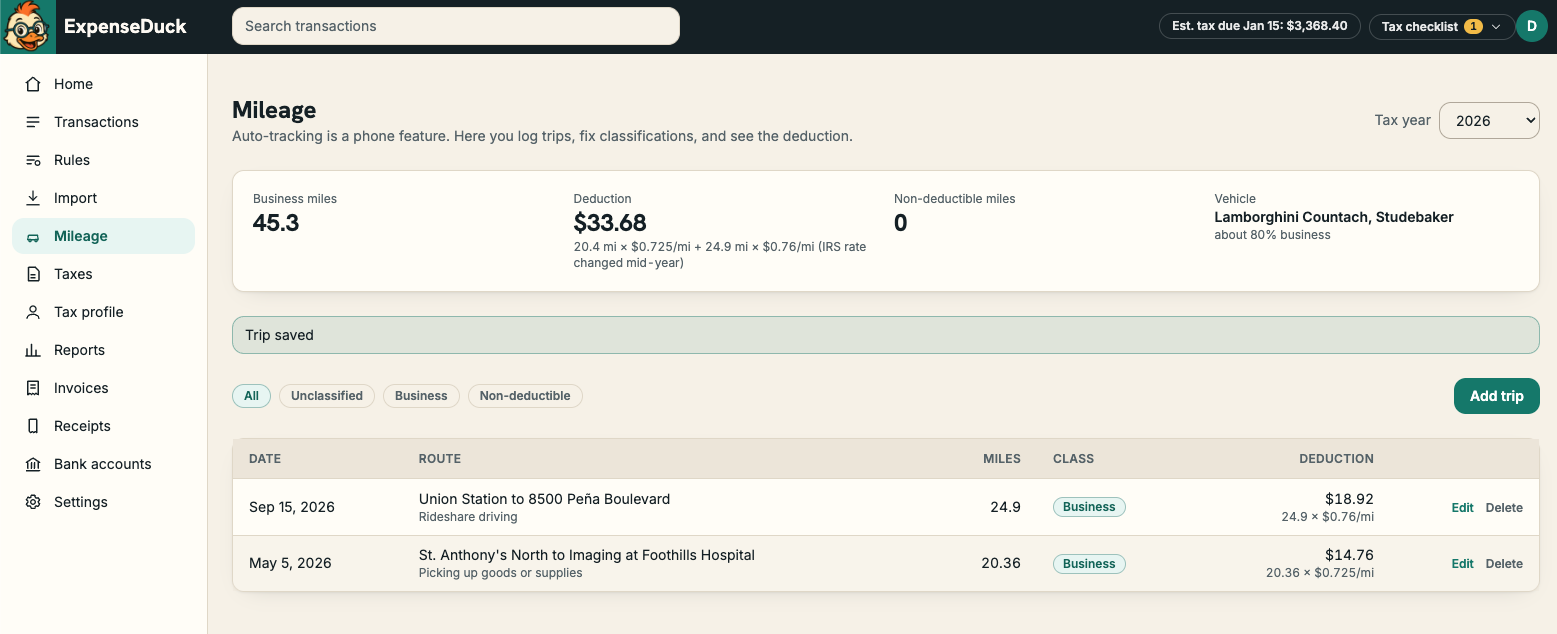

IRS mileage rate 2026 changed mid-year under Announcement 2026-11; ExpenseDuck stores the date of every drive and applies the rate that matches it.
LITTLETON, CO, UNITED STATES, October 6, 2026 /EINPresswire.com/ — IRS mileage rate 2026 for business driving is 72.5 cents per mile from January 1 through June 30 and 76 cents per mile from July 1 through December 31, under IRS Notice 2026-10 and Announcement 2026-11. Which rate applies depends on the date of each drive. ExpenseDuck records that date automatically and applies the matching rate.
The first-half rate came out of IR-2025-128 on December 29, 2025, announcing Notice 2026-10, which set 72.5 cents for 2026, up 2.5 cents from the 70 cents of 2025. The second-half rate came in Announcement 2026-11, published in Internal Revenue Bulletin 2026-29 on July 13, 2026. It raised business driving to 76 cents from July 1 and said the change “results from recent increases in the price of fuel.” The medical and moving rate rose the same way, from 20.5 cents to 23.5 cents on July 1. The charitable rate stayed at 14 cents, which is set by law.
The last mid-year change came on July 1, 2022, when IR-2022-124 raised the business rate to 62.5 cents and the IRS wrote that “midyear increases in the optional mileage rates are rare.” Before that the previous one was in 2011, according to the same release.
A driver with 10,000 business miles split evenly across 2026 deducts 5,000 miles at 72.5 cents, or $3,625, plus 5,000 miles at 76 cents, or $3,800, for $7,425 in total. The same 10,000 miles at the first-half rate alone would be $7,250, so an undated log costs the driver $175 for every 10,000 miles. A log that puts every drive at 76 cents overstates the deduction by the same $175.
IRS Publication 463 says the records behind a mileage deduction need to show the date, the miles, the destination and the business purpose of each trip, kept in an account book, diary, log or similar record at or near the time of the drive. The publication calls those timely-kept records. A total you add up in April does not count, and neither does a log where you guessed at the dates later.
ExpenseDuck is an automatic mileage tracker for people who file Schedule C. It records each business drive as it happens and stores the date and route, then applies 72.5 cents to drives dated June 30 or earlier and 76 cents to drives dated July 1 or later. The user swipes each drive as business or personal. The company’s page, IRS mileage rate 2026 explained, walks through the same math and what to do if you never wrote down your drives from the first half of the year.
“If half the trips in your paper log have no date, that log got a lot less useful on tax day. The IRS requires dates for every trip now, and almost nobody can produce that from memory in April.,” said Dave Rodenbaugh, founder of ExpenseDuck.
ExpenseDuck early access begins October 1, 2026, with sign-up open now and a public launch later in October, according to the company. The app also sorts expenses into Schedule C categories, matches receipts sent by photo or email to their transactions, estimates federal quarterly taxes (federal only), and imports transactions and mileage from QuickBooks Self-Employed. It runs in a web browser on a phone or a desktop, and iPhone support is coming soon, pending App Store approval. The single plan costs $14.99 a month after a 30-day free trial with no credit card required, as published on the ExpenseDuck pricing page.
Q: What is the IRS mileage rate for 2026?
A: There are two. Business driving is 72.5 cents per mile for drives from January 1 through June 30, 2026, under IRS Notice 2026-10, and 76 cents per mile for drives from July 1 through December 31, 2026, under Announcement 2026-11. Medical and moving miles are 20.5 cents and then 23.5 cents over the same two periods, and charitable miles are 14 cents all year. The IRS lists all of them on its standard mileage rates page.
Q: What does the IRS require in a mileage log?
A: IRS Publication 463 asks for four things for each business trip: the date, the miles, the destination and the business purpose. The publication says to keep them in an account book, diary, log or similar record made at or near the time of the drive, which it calls timely-kept records. For 2026 the date also decides whether the trip is worth 72.5 cents or 76 cents a mile.
Q: Does DoorDash track mileage for Dashers, and is that enough?
A: DoorDash’s help center says it emails Dashers who drove a car an estimate of their on-delivery mileage by January 31, and it tells them to consult a tax professional about deductions. That figure is one number for the year, so it cannot be split at July 1, and by DoorDash’s own description it counts on-delivery miles only. To support the deduction, keep a dated log of every business drive, as Publication 463 describes.
Q: How do I reconstruct mileage for the first half of the year?
A: Go find things that already have dates on them. The trip history in your delivery app, your calendar, the invoices you sent clients, and the mileage written on your oil change receipts all show where you were and when. Use those to write down each trip from January through June with its date, miles, destination and reason, which is what IRS Publication 463 asks for. Then let an app record the drives from here on so you never have to do this again.
About ExpenseDuck
ExpenseDuck is a bookkeeping and federal tax estimate app for solo U.S. freelancers who file Schedule C. It records business drives automatically at the IRS mileage rate, sorts expenses into Schedule C categories, matches receipts to transactions, and shows how much to set aside for federal quarterly taxes. It imports transactions and mileage from QuickBooks Self-Employed. ExpenseDuck runs in a web browser on a phone or a desktop and costs $14.99 a month after a 30-day free trial. ExpenseDuck is a trade name of Skyline Consulting, a Littleton, Colorado company that also makes DeductibleDuck. ExpenseDuck is not affiliated with Intuit, QuickBooks or TurboTax. Learn more at https://expenseduck.com.
Dave Rodenbaugh, Founder and CEO
ExpenseDuck
support@expenseduck.com
Legal Disclaimer:
EIN Presswire provides this news content “as is” without warranty of any kind. We do not accept any responsibility or liability
for the accuracy, content, images, videos, licenses, completeness, legality, or reliability of the information contained in this
article. If you have any complaints or copyright issues related to this article, kindly contact the author above.

Media gallery