
The Pentagon poured $151 million into technology most Americans have never heard of. Does that make it a good investment?
The Motley Fool reports the Pentagon invested $151 million in quantum computing, a promising yet unproven technology

Press Release Disclaimer: This is a press release distributed through the XPR Media network. It has not been independently verified by our newsroom.

PJ McDonnell // Shutterstock
The Pentagon poured $151 million into technology most Americans have never heard of. Does that make it a good investment?
Quantum computing occupies a strange place in the investing universe. The technology promises to revolutionize everything from drug discovery to cryptography, and it overlaps with artificial intelligence in ways that could accelerate both fields.
While traditional computers process information one step at a time using bits that are either 0 or 1, quantum computers use qubits that can represent both states at once. This gray-scale quality allows them to explore many possible answers simultaneously, potentially solving certain complex problems far faster. For investors, that could unlock meaningful gains in lucrative industries, but the technology is unproven at scale, and the handful of pure-play quantum computing stocks are not yet profitable.
Still, the federal government keeps writing checks to accelerate research in this field. Retail investors search for IonQ and Rigetti hundreds of thousands of times per month. Others have turned to quantum computing ETFs to spread their bets across the sector. Yet, most of those contracts have had no material, long-term impact on share prices, according to a Motley Fool analysis. As of mid-2026, over the past year, a basket of 11 pure-play quantum stocks tracked in this analysis has trailed the Nasdaq-100.
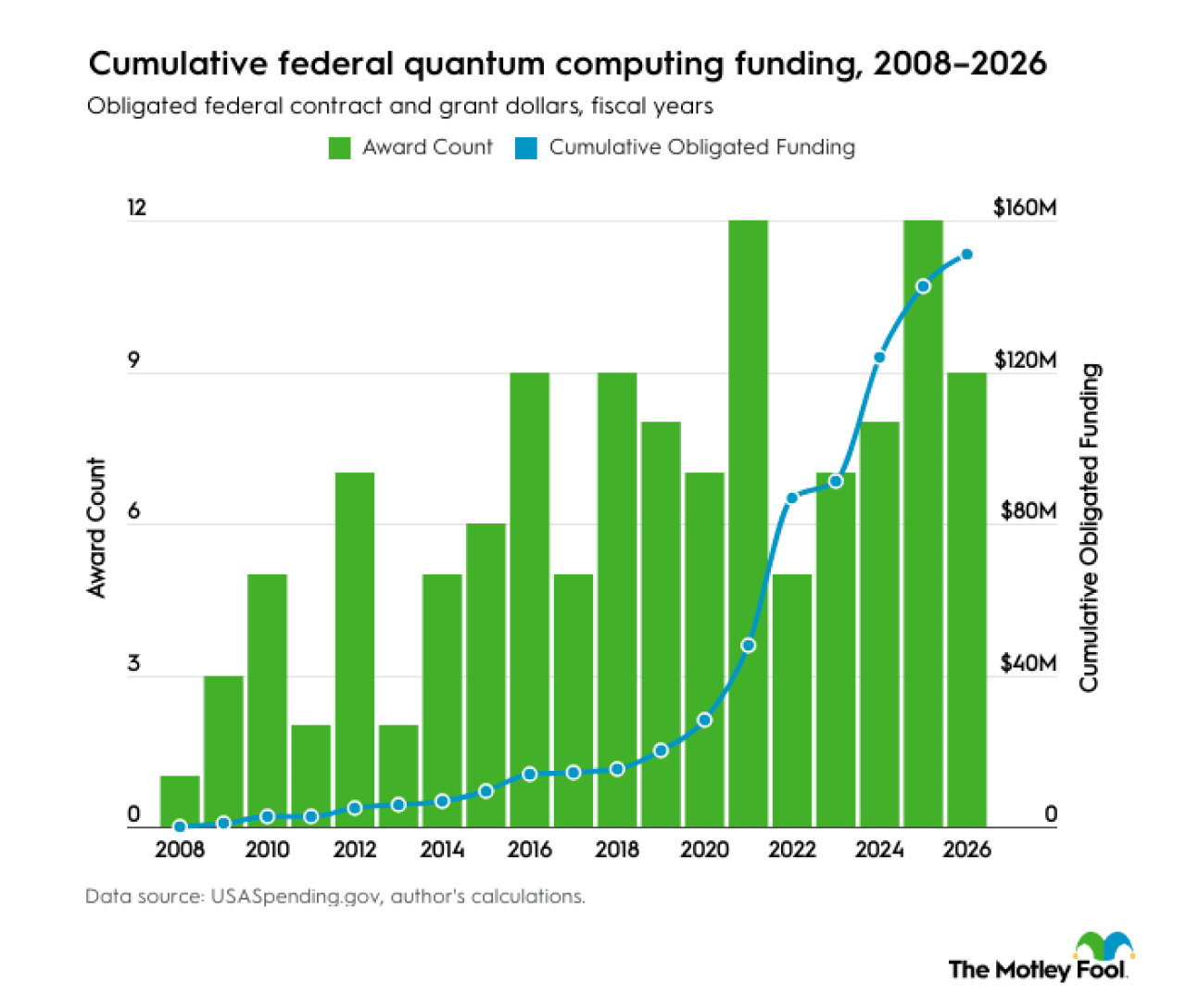
That gap between enthusiasm and returns tells a promising story. Quantum computing is real, the game-changing potential is undeniable, and the government funding is serious. With $151 million in obligated federal dollars since 2008, the U.S. Department of Defense is picking up most of the tab so far. This next-generation computing technology has massive implications for national security, so the DoD needs to take a deep interest in it. The U.S. wants to be on the leading edge if and when quantum computers start to break encryption or revolutionize military strategy.
Still, a Motley Fool analysis of stock price reactions to individual contract awards found that government money rarely moves these stocks in any lasting way.
This is actually good news, in a counterintuitive way. It means investors can stop chasing funding headlines and start evaluating these companies on what actually matters: the technology, the competitive landscape, and the long road to commercialization.
The Motley Fool
Which quantum computing companies have received the most government funding?
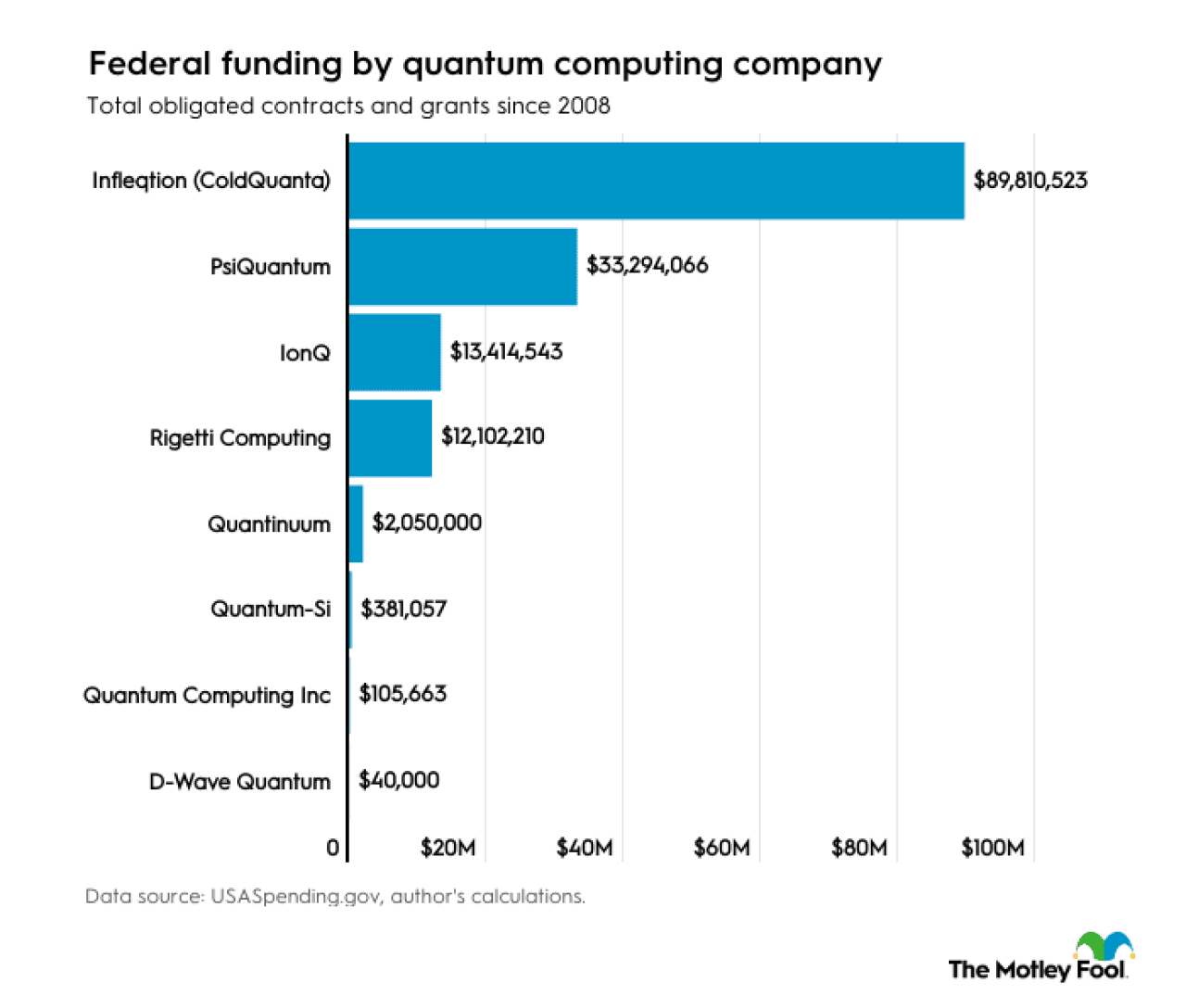
Federal funding has not been distributed evenly across the quantum computing sector. Infleqtion, formerly known as ColdQuanta, leads all companies with approximately $90 million in obligated federal dollars since 2008. IonQ, Rigetti Computing, and privately held PsiQuantum round out the top four recipients, though the total figures for those three companies fall below Infleqtion’s share.
Infleqtion leads federal funding because its neutral-atom technology operates at room temperature, allowing for portable, field-deployable hardware that pure-play computing rivals can’t match. This unique hardware enables the company to secure contracts for both long-term quantum computing and immediate national security needs, like GPS-free military navigation and quantum sensing. And the company has been around for decades under two different names.
Ultimately, its almost two-decade track record with agencies like DARPA and the DOD has made it the government’s most trusted partner for domestic quantum infrastructure. When the CHIPS funding came around, Infleqtion was poised to grab the lion’s share.
Then there is D-Wave Quantum, sitting at the bottom of the leaderboard with just $40,000 of federal funding awards. That is not a typo — forty thousand dollars, across almost two decades of federal quantum spending.
Five of the companies in this analysis have received exactly zero U.S. federal funding for one simple reason: Xanadu Quantum Technology, Horizon Quantum, Arqit Quantum, IQM Quantum Computing , and Diraq. The common thread? These five are headquartered outside the United States, which makes them ineligible for most federal contracts and grant programs.
The Motley Fool
The CHIPS Act complication
In May 2026, the Department of Commerce announced that nine quantum computing companies had signed letters of intent for $2.013 billion in CHIPS Act funding. That figure dwarfs the $151 million obligated over the prior 18 years. Headlines were written. Stocks popped. Investors got excited.
Twenty trading days later, every single one of those gains had evaporated.
The letters of intent are non-binding pledges, not actual money. Until binding agreements are signed and funds are formally obligated, the $2 billion exists only as a press release. This analysis excludes CHIPS Act pledges from all funding totals for that reason. That act brought significant funding to many semiconductor companies, but the quantum computing provisions were less impressive.
Do government contracts actually move quantum computing stocks?
The short answer: Rarely.
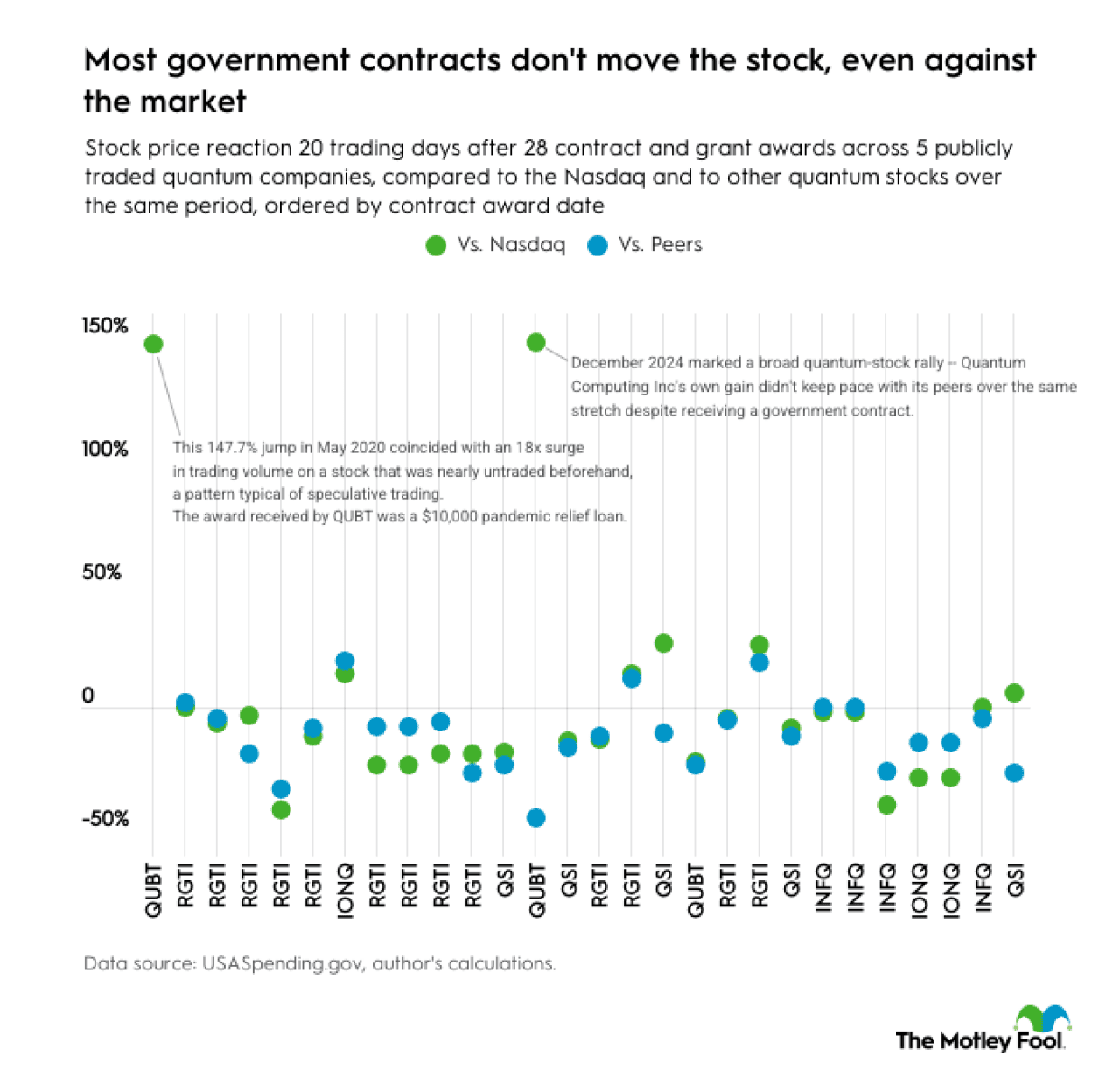
A Motley Fool analysis of stock price reactions to individual federal contract awards found that the typical contract produces no measurable long-term effect on share prices. This holds even after controlling for overall market movement and sector-wide swings among quantum peers.
If anything, the pattern runs slightly negative. Companies that received contracts tended to underperform both the Nasdaq and other quantum stocks in the weeks following an award. Buying quantum stocks on contract news would have been a losing strategy more often than not, especially if you didn’t see the temporary jump coming ahead of time. Most investors are locked in inflated starting prices with limited staying power.
The Motley Fool
The exception that proves the rule
IonQ’s stock did see significant, long-term gains after the company was awarded a $13.4 million Air Force Research Laboratory contract in 2022. The military ordered a trapped ion quantum computer from IonQ, and the stock posted a sustained double-digit gain that held up even after accounting for market and peer movements. IonQ delivered the computer in 2025. The Air Force isn’t using the system for military operations, but is gaining experience with quantum computing to take advantage of it once such systems become powerful enough. Early tests included sending quantum data via visible light signals — a first step toward combining quantum computing with fiber-optic communications equipment.
That contract was IonQ’s largest and most heavily publicized award, though. The lesson: a contract has to be big enough and newsworthy enough to break through the noise. A $2 million award buried in a government database doesn’t move the needle, and the money isn’t enough to fund quantum research with market-moving implications in the long run.
Should government contracts factor into a quantum computing investment?
Here is the honest answer: government funding is a signal that smart people in national security think quantum computing matters. It is not a guarantee (or even a suggestion) that any particular stock is about to go up.
The CHIPS Act announcement moved prices for about three weeks. Individual contracts barely register. Investors who built a strategy around chasing government headlines would have been disappointed repeatedly.
That finding is not an argument against quantum computing stocks. It is an argument for tuning out the funding noise.
The technology has genuine long-term potential, and the federal government’s continued interest is one data point in its favor. But “the government gave this company money” is not an investment thesis. It is a headline, quickly forgotten on Wall Street and rarely making a notable difference to the company’s business prospects.
Investors interested in quantum computing have better questions to ask. Which companies are making technical progress? Who has a credible path to commercialization? What does the competitive landscape look like in five years? Those questions are harder to answer than “who got the biggest contract,” but they are the ones that matter.
The next government headline is unlikely to provide a useful signal for any of those factors.
Methodology
Federal funding figures in this article come from USAspending.gov, the federal government’s public record of contract and grant spending. Each company was matched to its exact federal registration number, known as a Unique Entity Identifier, rather than by company name alone. Every total was checked against individual award records before publication.
This article tracks 11 publicly traded and two privately held, pure-play quantum computing companies, meaning quantum computing is each company’s core business, not a division or side project within a larger technology company. Eight have received direct federal funding: Infleqtion, IonQ, Rigetti, Quantinuum, Quantum-Si, Quantum Computing Inc, D-Wave, and PsiQuantum. Five have received none: Xanadu, Horizon Quantum, Arqit, IQM, and Diraq. This pure-play criterion is why companies like IBM and GlobalFoundries are excluded from the company comparisons even though both received CHIPS Act pledges: quantum computing is a small part of each company’s much larger business, and neither isolates its quantum-specific federal funding in public records.
Figures reflect obligated dollars: money the government has formally committed, not proposed or requested amounts, and not contract ceiling values that may never be paid out. Some federal awards are issued under shared, multi-company contract vehicles known as Indefinite Delivery Vehicles. The full ceiling value of one such vehicle, roughly $151 billion, was excluded from this analysis because it represents money available to every company on the vehicle combined, not a commitment to any single company.
Data covers fiscal year 2008 through July 2026, across both federal contracts and grants.
Stock price reactions to individual contract awards are measured against two benchmarks: the Nasdaq Composite, to account for overall market movement, and an equal-weighted average of the other publicly traded quantum computing companies tracked in this article, to account for sector-wide swings. A stock’s raw price change in the days after a contract is not, on its own, evidence that the contract caused the move; comparing it to how the market and peer companies moved over the same days isolates the contract’s likely effect from broader trends.
Letters of intent for $2.013 billion in CHIPS Act funding, announced by the Department of Commerce on May 21, 2026, are not included in any funding total in this article. A letter of intent is a non-binding pledge, and the money will not appear in federal spending records until a binding agreement is signed and funds are formally obligated.
This story was produced by The Motley Fool and reviewed and distributed by Stacker.


