Virtual Care’s Next Growth Opportunity is Turning Positive Patient Experiences into Routine Use, New Bridge Report Finds
National survey of 2,016 U.S. adults identifies insurance barriers and untapped interest in specialty virtual care as

Press Release Disclaimer: This is a press release distributed through the XPR Media network. It has not been independently verified by our newsroom.


While patients still prefer in-person treatment, virtual care has gained trust and adoption, according to Bridge’s newly released 2026 Virtual Care Report. An overwhelming majority (91%) of virtual care users reported satisfaction with their experience. Approximately two-thirds of virtual care users said that their most recent virtual visit fully resolved their health issue, while 80% said they would be likely to use virtual care again for the same type of issue.
This press release features multimedia. View the full release here: https://www.businesswire.com/news/home/20261112472060/en/
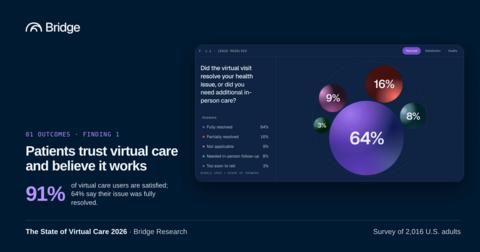
While patients still prefer in-person treatment, virtual care has gained trust and adoption, according to Bridge’s newly released 2026 Virtual Care Report.
The report, based on a national survey of 2,016 U.S. adults, examines how consumers find, use and pay for virtual care, and identifies factors that could influence its next phase of growth. The research was commissioned by Bridge, a healthcare services and technology company that simplifies health insurance access for virtual care.
“Virtual care has proven its value, and patients are overwhelmingly satisfied with their experiences. The question is then how we move beyond virtual care as a convenient, one-time solution and make it a trusted, ongoing part of how people manage their health,” said Keaton Bedell, co-founder and CEO of Bridge. “We created this report to help virtual care providers understand when and why patients choose virtual care, what they use it for, and what barriers prevent them from using it more often.”
The findings point to several factors shaping virtual care’s next phase, including the influence of existing provider relationships, the importance of insurance coverage and untapped consumer interest in virtual specialty care. High-level themes are presented below, and an in-depth, interactive report is available here.
When patients look for virtual care, they turn to their own doctor.
More than half (56%) of patients got virtual care from their regular provider. Only 18% used a standalone virtual care company. When asked how they find or choose virtual care options, the majority of consumers either used offerings from their regular provider or followed referrals from them. Only 11% reported finding virtual care options through their employer.
Patients want to use insurance to pay for virtual care.
Patients want, and expect, virtual care to be covered by their insurance, as 88% said insurance coverage matters when deciding whether to use virtual care, and 89% had their last virtual visit covered by insurance. Only 7% paid cash, and just 2% had a visit fully covered by an employer benefit.
When insurance coverage surfaces as an obstacle, patients defer care or use a more expensive alternative, such as urgent care or the ER. In fact, a third of patients who were prevented from seeing a desired virtual care provider went to urgent care instead, and 1 in 6 went to the ER.
Consumers are open to additional use cases for virtual care, specifically seeing specialists virtually.
Patients reported a wide range of use cases for virtual care. The top three drivers were follow-up care for an existing condition (33%), routine and preventive care (27%), and medication refills (26%). Patients also believe virtual care can handle more than a single visit, as 65% said it works for follow-ups and medication questions, and more than half said it can manage or monitor an ongoing condition.
Survey respondents were also presented with a list of virtual specialty care options, ranging from weight management and women’s health to dermatology, liver care and sleep medicine. They were asked if they were aware of each specialty, if they had engaged virtually with each specialty, and if they would consider using virtual care to access each specialty in the future.
A lack of awareness emerged as a major barrier to engagement with specialty virtual providers. While 62% of users would consider at least one specialty they didn’t know was offered virtually, 39% of virtual care users who reported no engagement with virtual specialties were not aware that virtual was an option for specialty care.
Another signal that specialty care is ready to expand: 75% of consumers said they wouldn’t wait more than two weeks for an in-person specialist before opting for a same week appointment with a virtual specialist.
“This data challenges some longstanding conventional wisdom about how patients find and pay for virtual care,” Bedell said. “It also offers evidence that consumers are primed for more, and expecting more, from virtual care moving forward.”
About the 2026 Virtual Care Report
Bridge designed the consumer survey fueling the Virtual Care Report, and independent research firm Dynata fielded it in August 2026 through a national online panel of U.S. adults aged 18 and older. Quotas were set on age, gender, region and virtual care use. Of the 2,016 total respondents, 1,814 (90%) had previously completed a video or phone visit with a licensed provider, while 202 had no previous experience with virtual care. Access the full report here.
About Bridge
Bridge is a healthcare services and technology company that makes it easier for virtual care providers to accept insurance and scale nationwide. We simplify the complexities of payer contracting, provider credentialing, insurance billing and regulatory compliance, helping virtual care companies expand patient access and build sustainable businesses. Bridge’s nationwide network spans all 50 states and more than 50 medical specialties providing access to over 200 million members. By removing the operational and financial barriers to growth, Bridge enables healthcare innovators to focus on what matters most: delivering high-quality patient care. Learn more at www.usebridge.com.
View source version on businesswire.com: https://www.businesswire.com/news/home/20261112472060/en/
Media gallery