AskEffi: As AI accelerates IT projects Delivery, Bottleneck shifts to the Executive decision making
Interviews with 60+ delivery leaders reveal the blind spot; AskEffi's intelligence layer closes it. A case study shows

Press Release Disclaimer: This is a press release distributed through the XPR Media network. It has not been independently verified by our newsroom.
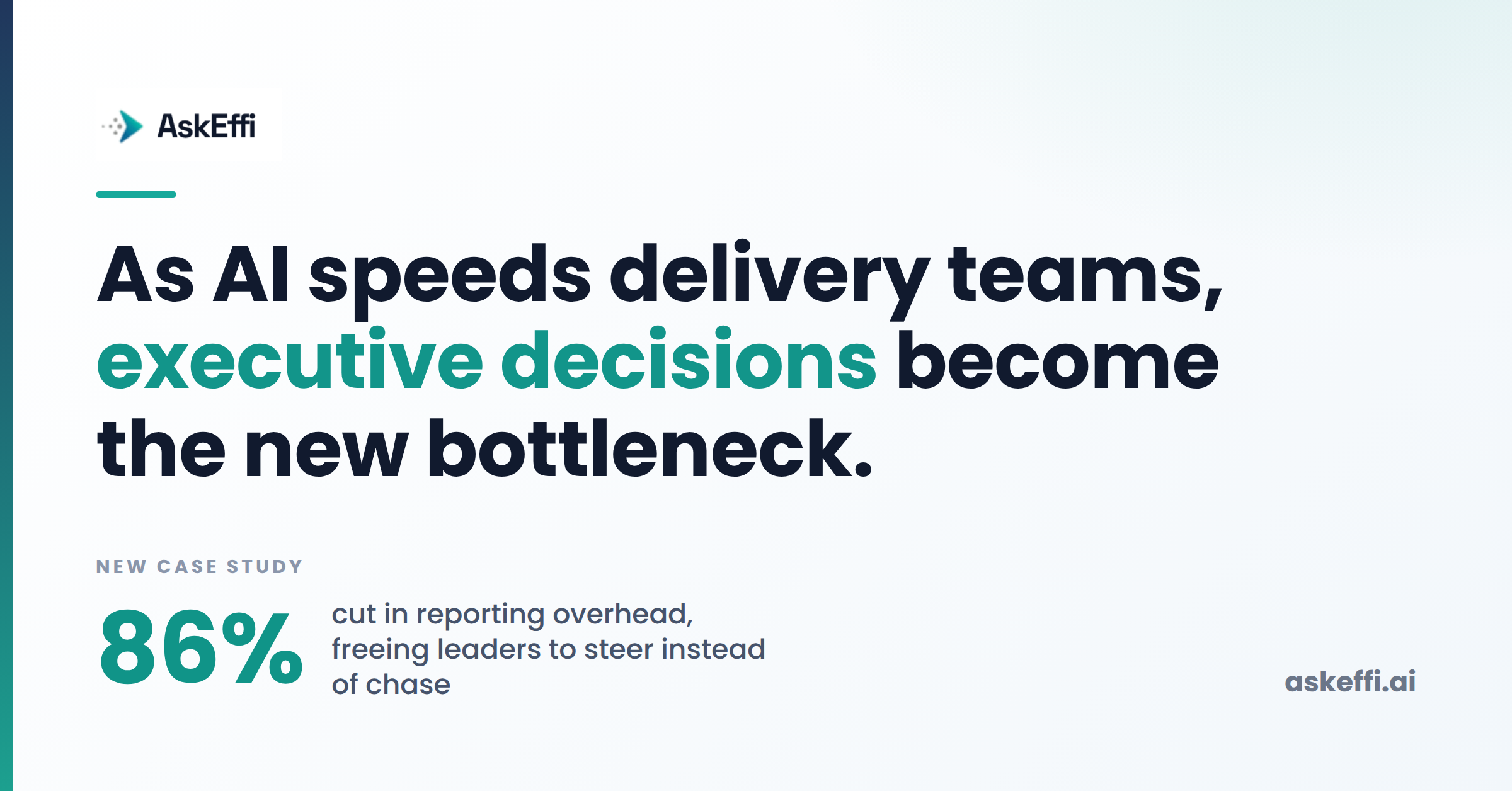

Interviews with 60+ delivery leaders reveal the blind spot; AskEffi’s intelligence layer closes it. A case study shows an 86% cut in reporting overhead.
REDWOOD CITY, CA, UNITED STATES, August 11, 2026 /EINPresswire.com/ — Executive decision-making is becoming the new bottleneck in complex IT delivery, and AI is the reason. As AI accelerates the pace of delivery teams on ERP rollouts and platform migrations, the constraint is no longer how fast the work gets done — it is whether the executive accountable for the project can stay on top of it and make the right calls in time. That is the central finding of more than 60 interviews with delivery leaders conducted by AskEffi, an intelligence layer for project delivery leaders — software that surfaces status and risk from the emails, meetings and documents behind a project. The company today published a customer case study documenting the pattern and pointing to a potential remedy.
As pricing moves from time-and-materials to outcome-based contracts, a risk caught late comes out of the delivery firm’s margin, not the client’s budget. The exposure is well documented: a McKinsey and University of Oxford study of 5,400 large IT projects found they ran, on average, 45 percent over budget — and PMI finds that of every $1 billion spent on projects, $75 million is put at risk by ineffective communications, the very signals that reach the accountable leader late, if at all.
The interviews put the human cost in plain terms. “When something goes wrong, you may hear about it from your team, your client or your boss. Hearing from the team is the best case; hearing from your boss is the worst — then the clock is ticking for you to show you’re on top of the situation,” said Guy Levit, founder of AskEffi. “As a result, leaders face immense pressure — to focus on new business and expansion on one hand, while investing just enough in existing business to stay ahead of those escalations. This becomes harder as AI accelerates execution,” he added.
The interviews also surfaced a counterintuitive gap in how AI is helping. Implementation-specific agents now help with technical work like requirement gathering and data migrations, making decision-making more frequent and time-sensitive. When nuanced decisions or risks surface, they typically require a granular view of reality on the ground. A leader at the second or third line of escalation is not on most of the threads and meetings, so an LLM grounded in the leader’s own inbox has little to draw on.
Effi, AskEffi’s agent, is designed to close that gap. It reads across a project’s existing communications — email, meeting notes and documents — and answers plain-language questions about status, decisions and risk, so the accountable leader has visibility without hours of manual digging. Effi can also proactively surface the questions a leader didn’t know to ask, flagging gaps, risks and upcoming decisions on its own. It works alongside existing project-management and professional-services-automation (PSA) systems rather than replacing them.
Early results suggest the bottleneck can be eased. Mkenga Na Namwaka, a Chicago firm that runs a portfolio of concurrent enterprise implementations, adopted AskEffi after its founder, Elsante Mnzava, found he had no reliable way to gauge how work was progressing. “My team would walk me through what was done. Whether it was actually done to the standard the project needed, there was no way I could tell,” Mnzava said.
After adopting the platform, the firm cut its reporting overhead by 86 percent — freeing roughly a tenth of its capacity for delivery work — and, by Mnzava’s estimate, client engagement roughly tripled as clients began responding to weekly updates and surfacing risks earlier. In one case, AskEffi flagged a missing integration requirement the team had not raised on its own. “Five minutes in, I leave knowing nothing’s fallen through the cracks, and exactly what needs to be addressed,” Mnzava said.
These pressures are unlikely to ease: as AI accelerates delivery and outcome-based pricing spreads across professional services, leader-level visibility is becoming less a convenience than a condition of protecting margin.
About AskEffi — AskEffi is an intelligence layer for project delivery leaders at system integrators and consulting firms running complex enterprise implementations. The full Mkenga Na Namwaka case study is available at askeffi.ai/case-study/.
Guy Levit
AskEffi
info@askeffi.ai
Legal Disclaimer:
EIN Presswire provides this news content “as is” without warranty of any kind. We do not accept any responsibility or liability
for the accuracy, content, images, videos, licenses, completeness, legality, or reliability of the information contained in this
article. If you have any complaints or copyright issues related to this article, kindly contact the author above.

Media gallery