
Global Counter UAS Market to Reach US$ 18,289.23 Million by 2035 Amid Rising Demand for Advanced Drone Defense Solutions
The Counter UAS Market was valued at US$ 1,610 million in 2024 and is projected to reach US$ 18,289 million by 2035,

Press Release Disclaimer: This is a press release distributed through the XPR Media network. It has not been independently verified by our newsroom.
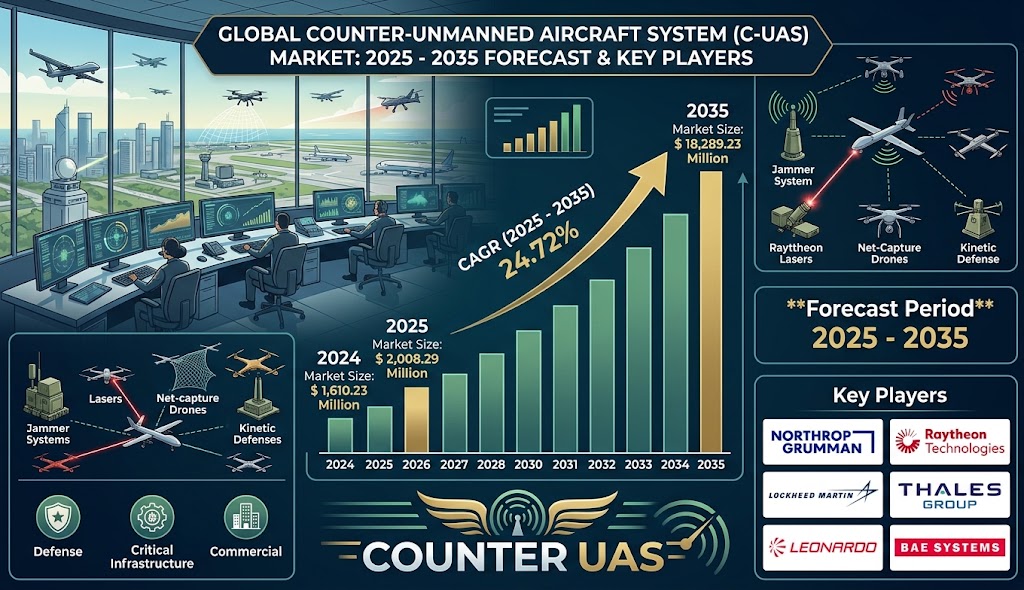

The Counter UAS Market was valued at US$ 1,610 million in 2024 and is projected to reach US$ 18,289 million by 2035, registering a CAGR of 24.72% from 2025.
NEW YORK, NY, UNITED STATES, August 24, 2026 /EINPresswire.com/ — The rapid expansion reflects increasing security concerns, technological advancements, regulatory developments, military modernization, and the growing requirement for effective protection against unauthorized unmanned aerial systems.
Counter UAS Market Overview:
The Counter UAS Market is developing rapidly as governments, defense organizations, security agencies, commercial enterprises, and infrastructure operators seek technologies capable of detecting, tracking, identifying, and neutralizing unauthorized unmanned aerial systems. MRFR estimates that the market will increase from USD 2,008.29 million in 2025 to USD 18,289.23 million by 2035. The forecast represents a significant expansion in demand for integrated counter-drone capabilities across military, homeland security, commercial, public safety, and infrastructure applications.
Counter-UAS solutions encompass multiple technologies and components designed to address drone-related security risks. Detection capabilities include radar, RF scanners, electro-optical/infrared systems, acoustic systems, and combined sensors, while interdiction solutions include jammers, spoofing, lasers, and nets. Technology categories include laser systems, kinetic systems, and electronic systems, supported by different configurations and platforms.
Request for Free Sample of Report: https://www.marketresearchfuture.com/sample_request/7430
The market is also influenced by the increasing sophistication and accessibility of unmanned aerial systems. As drones become more widely utilized across commercial and operational environments, concerns surrounding unauthorized drone activity have increased. This has encouraged stakeholders to invest in advanced counter-drone systems that can strengthen airspace awareness and security.
North America currently represents the largest regional market, accounting for approximately 49% of global market share. The United States leads within North America with approximately 42% of the global market, supported by defense procurement, deployments at military bases and airports, and a developed domestic counter-UAS technology ecosystem.
Market Trends:
1. Rising Investment in Counter-UAS Countermeasures
One of the most important trends shaping the Counter UAS Market is growing investment in counter-UAS countermeasures. The increasing prevalence of unmanned aerial systems has expanded their potential applications while also increasing concerns regarding misuse. Governments and private organizations are consequently focusing on technologies capable of addressing unauthorized drone activity.
This trend is encouraging innovation in drone detection and neutralization technologies. Radar systems, RF scanners, EO/IR technologies, acoustic systems, and combined sensors are becoming important components of integrated security architectures. The focus is increasingly moving toward systems that can provide timely identification and response capabilities.
2. Integration of Artificial Intelligence and Machine Learning
The integration of artificial intelligence and machine learning represents another significant trend. AI and machine learning technologies can enhance detection and response capabilities, supporting more effective identification of potential aerial threats. Their integration with existing counter-UAS technologies is contributing to improvements in overall system effectiveness.
Regulatory frameworks are developing alongside technological progress. Authorities are establishing guidelines for drone operations, particularly in sensitive environments, influencing how organizations approach counter-UAS deployments. Public-private collaboration is also becoming increasingly important as stakeholders seek innovative solutions that support both security and safe drone usage.
3. Increasing Public-Private Collaboration
Collaboration between government organizations and private technology providers is supporting market maturity. Public agencies require advanced security capabilities, while technology companies are developing systems that respond to evolving operational requirements. This interaction is contributing to innovation across detection, identification, tracking, and neutralization capabilities.
Market Drivers:
1. Regulatory Developments
Regulatory developments are a major factor supporting the Counter UAS Market. Governments are implementing stricter requirements for drone operations, especially around airports, military installations, and public events. Such regulatory pressure can increase the need for counter-drone technologies that support safety and compliance.
The report identifies regulatory developments as an important market dynamic because organizations must increasingly account for unauthorized drone activity when managing sensitive airspace. As regulations evolve, demand for counter-UAS capabilities is expected to increase.
2. Technological Advancements
Technological advancement in detection and neutralization systems is another major market driver. Radar, radio-frequency jamming, laser-based solutions, and AI-supported detection technologies are improving the ability of organizations to identify and respond to rogue drones.
Electronic systems are particularly important in this environment. Electronic warfare holds the largest share among technology segments, reflecting the adoption of electronic systems for disrupting and neutralizing unmanned aerial systems. Kinetic interception is also gaining traction because of its ability to directly neutralize aerial threats.
3. Increasing Security Concerns
Growing security concerns across military, commercial, and critical infrastructure environments are creating additional demand. Unauthorized drones can disrupt operations and compromise safety, encouraging organizations to deploy systems designed to improve airspace protection.
The increasing use of drones across multiple sectors further reinforces this requirement. As drone activity expands, stakeholders are becoming more aware of vulnerabilities associated with unauthorized aerial operations, supporting investment in integrated counter-UAS solutions.
4. Military Modernization
Military modernization is a significant contributor to market expansion. Armed forces increasingly recognize the importance of countering drones used for reconnaissance, surveillance, and attacks. Consequently, military organizations are investing in advanced systems designed to detect and neutralize drone threats.
The Military and Defense end-use segment accounted for an estimated 55% of global market share in 2025, making it the largest end-use segment. The dominance reflects increasing use of hostile drones and the military’s focus on airspace denial and force protection.
5. Expansion of Commercial Applications
Commercial applications are also creating opportunities for the industry. Businesses operating in aviation, energy, public safety, logistics, agriculture, and surveillance are increasingly aware of potential unauthorized drone activity. Airports, large public events, corporate facilities, and infrastructure sites can require additional airspace security measures.
The commercial segment is identified as the fastest-growing application segment. Enhanced regulatory frameworks and technological developments are making counter-UAS solutions increasingly accessible to businesses and civilian organizations.
Market Opportunities:
1. AI-Enabled Counter-UAS Solutions
The integration of advanced artificial intelligence into counter-UAS systems presents a major opportunity. AI-enabled technologies can strengthen threat identification and response capabilities, creating opportunities for technology developers to improve detection accuracy and operational efficiency.
The report specifically identifies the integration of advanced artificial intelligence as a key market opportunity. As counter-UAS technologies mature, AI can increasingly support sophisticated detection and response architectures.
2. Integration with Existing Defense Systems
Another opportunity lies in integrating counter-UAS solutions with existing military defense systems. Rather than operating as isolated technologies, counter-UAS capabilities can complement established defense infrastructure and contribute to broader airspace protection strategies.
This opportunity is particularly relevant for military organizations seeking to strengthen capabilities without relying exclusively on standalone solutions. Integration can also support coordinated detection and response across different operational environments.
3. Commercial and Airport Protection
The expansion of counter-UAS applications into commercial environments provides another growth opportunity. Airports, public events, energy facilities, and other sensitive locations can represent potential demand centers as organizations seek to protect operations against unauthorized drone activity.
The report identifies expansion into commercial sectors, including airports and large public events, as an important future opportunity.
Segmental Analysis:
The Counter UAS Market is segmented by application, technology, end use, platform, and component, providing a broad view of demand across different operational requirements.
1. By Application
Military applications hold the largest share, reflecting the importance of counter-UAS capabilities in national defense and security. Military users require technologies capable of detecting, tracking, and neutralizing unmanned aerial systems in operational environments.
Commercial applications represent the fastest-growing segment. Increased awareness of UAS-related risks, technological advancement, and regulatory development are supporting adoption by businesses, airports, and public-event operators.
2. By Technology
Electronic Warfare represents the dominant technology segment. Its ability to disrupt communication and navigation signals provides an important non-kinetic approach to countering hostile drones. The segment benefits from demand for technologies capable of neutralizing threats while minimizing the need for physical engagement.
Kinetic Interception is the fastest-growing technology segment. It provides a direct method of physically neutralizing UAS threats and is gaining interest as organizations seek immediate threat-neutralization capabilities. Cybersecurity and detection technologies are also becoming increasingly important as vulnerabilities associated with drone systems receive greater attention.
3. By End Use
Defense Forces represent the largest end-use segment. Their substantial investment in advanced technologies reflects the increasing importance of countering aerial threats in military operations.
Law Enforcement Agencies are identified as the fastest-growing segment. Urban environments, public events, and increasing unauthorized drone activity are encouraging law enforcement organizations to strengthen drone detection and response capabilities.
4. By Platform
Ground-Based Systems dominate the platform segment. Their extensive deployment across military, security, and critical infrastructure applications is supported by established technologies and versatile operational capabilities.
Airborne Systems are emerging rapidly as the fastest-growing platform category. Their mobility, broader surveillance capabilities, and ability to operate in dynamic environments are supporting increased interest.
5. By Component
Sensors represent the largest component segment. Sensors are fundamental to detecting and identifying unmanned aerial systems and form a critical part of counter-UAS architectures.
Control Systems are emerging rapidly because of their increasing role in managing detection, tracking, and neutralization processes. Cameras, communication systems, and power supplies also contribute to the broader counter-UAS technology ecosystem.
Regional Analysis:
North America leads the Counter UAS Market, accounting for approximately 49% of the global market. Extensive defense spending, increasing awareness of drone threats to critical infrastructure, and the presence of a mature counter-drone technology ecosystem support regional leadership.
The United States is the leading country in North America and represents approximately 42% of the global market. Significant Department of Defense procurement, deployment at military bases and airports, and a strong domestic technology industry contribute to the country’s position.
Europe represents another important regional market, supported by defense and security requirements and the development of counter-UAS capabilities. The region’s focus on managing drone operations and strengthening security contributes to demand.
Asia-Pacific is emerging as the fastest-growing regional market. Increasing security requirements and technological development are supporting regional adoption. The market’s expansion reflects the growing importance of counter-UAS solutions across military and security applications.
South America and the Middle East & Africa are also included within the report’s regional coverage. These markets provide additional opportunities as governments and organizations address security requirements associated with unmanned aerial systems.
Competitive Landscape and Company Profiles:
The Counter UAS Market features global, regional, and local technology providers competing across different areas of counter-UAS development. Competition is influenced by product quality, reliability, cost, technological capabilities, and aftermarket services.
Key companies profiled in the MRFR report include Northrop Grumman, Raytheon Technologies, Lockheed Martin, Thales Group, Leonardo, BAE Systems, DroneShield, Textron, and SAAB. These companies participate in the evolving counter-UAS ecosystem through technologies and solutions supporting detection, electronic countermeasures, interception, and integrated security capabilities.
1. Northrop Grumman is among the major companies identified in the competitive landscape and has capabilities associated with counter-drone command and control solutions.
2. Raytheon Technologies is another prominent participant, contributing to the broader defense technology landscape and counter-UAS capabilities.
3. Lockheed Martin is profiled as a major defense technology company participating in the competitive environment surrounding counter-UAS solutions.
4. Thales Group represents a major European participant, while Leonardo is another significant European company included among the key players.
5. BAE Systems is also profiled as a major participant in the global market. DroneShield, Textron, and SAAB further contribute to the competitive landscape, reflecting the broad international participation in counter-UAS technologies.
Recent Developments:
February 2023: South Korea’s top defense firm, Hanwha Aerospace, announced an investment in Fortem Technologies, a U.S. airspace security firm. The development reflects continuing investment and collaboration within the broader counter-UAS and airspace security ecosystem.
November 2022: Northrop Grumman’s short-range counter-drone command and control capability completed a live-fire test for the U.S. Army at Yuma Proving Ground, Arizona. The development demonstrates continued testing and advancement of counter-drone capabilities for defense applications.
Future Outlook:
The outlook for the Counter UAS Market remains highly positive. MRFR projects the market to expand from USD 2,008.29 million in 2025 to USD 18,289.23 million by 2035, reflecting a CAGR of 24.72% during the forecast period. The expansion is expected to be supported by increasing security concerns, technological advancements, regulatory developments, and growing investment in defense and security.
The continued development of AI-enabled detection systems represents a significant area of opportunity. Integration with existing military defense systems and expansion into airports, commercial facilities, and large public events can further broaden the addressable market.
At the same time, the evolution of electronic warfare, kinetic interception, detection systems, and countermeasures is expected to create a diverse technology landscape. The combination of these technologies can provide organizations with multiple approaches to addressing different types of UAS threats.
Conclusion:
The Counter UAS Market is entering a period of substantial expansion as the proliferation of unmanned aerial systems increases the need for effective airspace protection. With a valuation of USD 1,610.23 million in 2024 and a projected valuation of USD 18,289.23 million by 2035, the market is expected to register a strong 24.72% CAGR between 2025 and 2035.
Military and defense applications will remain central to industry development, while commercial and law enforcement applications are expected to expand rapidly. Electronic Warfare currently leads the technology landscape, while Kinetic Interception is emerging as a high-growth area. Ground-Based Systems continue to dominate platform demand, while Airborne Systems are gaining momentum.
North America is expected to maintain its leadership position, supported by strong defense spending and an established counter-UAS ecosystem, while Asia-Pacific offers significant growth potential. With continued investment in artificial intelligence, detection technologies, regulatory development, and integrated security solutions, the industry is positioned for continued innovation and expansion through 2035.
Browse More Reports:
Air Missile Defense Radar System Market
https://www.marketresearchfuture.com/reports/air-missile-defense-radar-system-market-1594
Military Radar Systems Market
https://www.marketresearchfuture.com/reports/military-radar-systems-market-1413
Naval Radar System Market
https://www.marketresearchfuture.com/reports/naval-radar-system-market-43590
Sagar Kadam
Market Research Future
628-258-0071
sales@marketresearchfuture.com
Legal Disclaimer:
EIN Presswire provides this news content “as is” without warranty of any kind. We do not accept any responsibility or liability
for the accuracy, content, images, videos, licenses, completeness, legality, or reliability of the information contained in this
article. If you have any complaints or copyright issues related to this article, kindly contact the author above.

Media gallery


