Sun Care Products Market to Reach USD 26.5 Billion by 2035 at 6.2% CAGR as UV Protection and Online Retail Drive Growth
The Sun Care Products Market is projected to reach USD 26.5 billion by 2035, driven by UV awareness, product

Press Release Disclaimer: This is a press release distributed through the XPR Media network. It has not been independently verified by our newsroom.
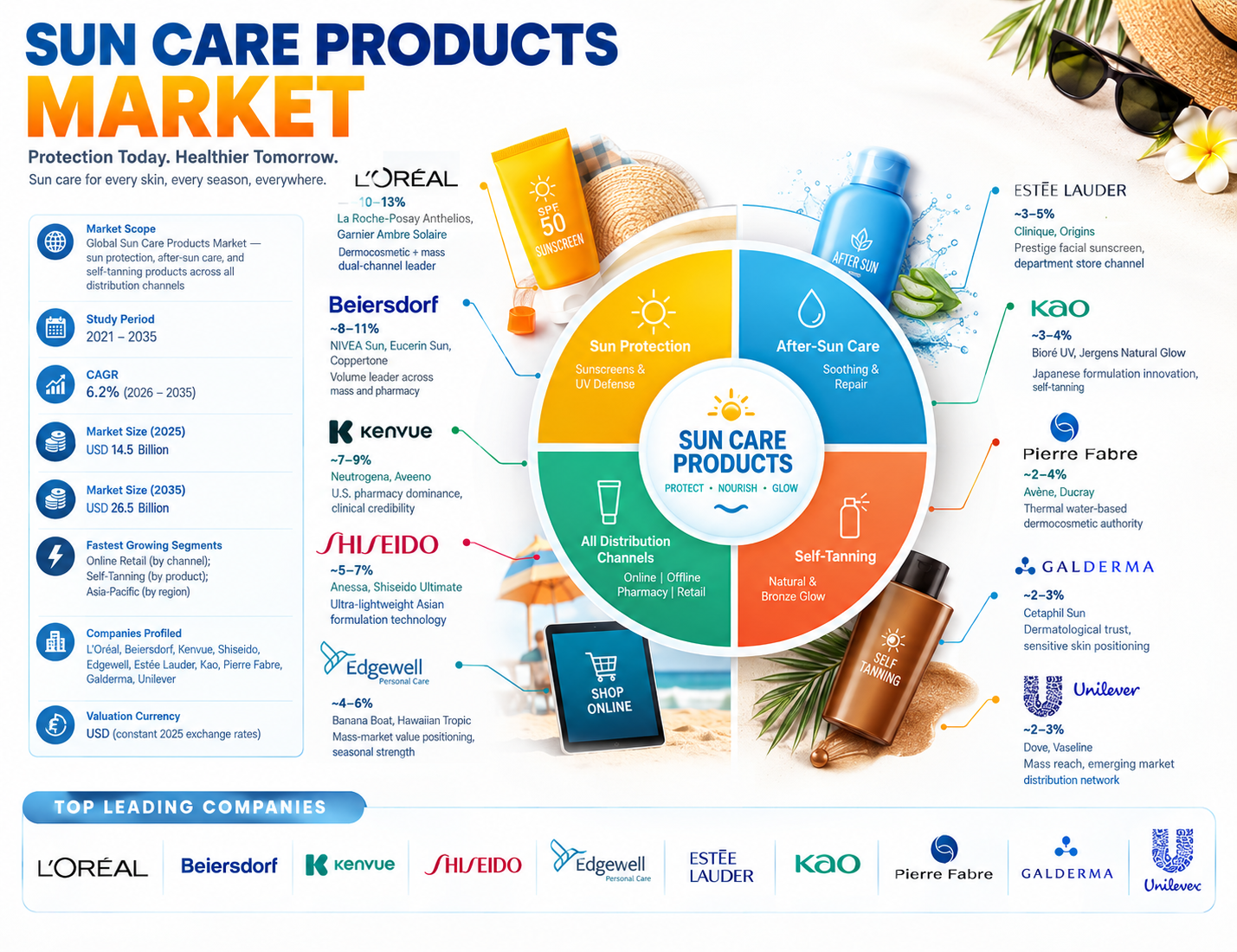

The Sun Care Products Market is projected to reach USD 26.5 billion by 2035, driven by UV awareness, product innovation, self-tanning, and online retail.
NEW YORK, NY, UNITED STATES, August 24, 2026 /EINPresswire.com/ —
The global Sun Care Products Market is entering a broader phase of expansion as consumers increasingly view ultraviolet (UV) protection as an everyday component of skincare rather than a product reserved for holidays, beaches, or summer months. The market includes sun protection products, after-sun care, and self-tanning products distributed through online and offline channels. Valued at approximately USD 14.5 billion in 2025, the market is projected to reach USD 26.5 billion by 2035, expanding at a 6.2% CAGR from 2026 to 2035. Rising awareness of premature skin aging, UV-related skin damage, changing beauty routines, and growing demand for multifunctional formulations are contributing to the market’s long-term development.
The competitive landscape is characterized by a combination of global beauty companies, dermatology-focused brands, consumer healthcare businesses, and specialized sun-care manufacturers. L’Oréal, Beiersdorf, Kenvue, Shiseido, Edgewell Personal Care, Estée Lauder, Kao Corporation, Pierre Fabre, Galderma, and Unilever represent important participants across different price tiers and geographic markets. L’Oréal maintains a diversified position through La Roche-Posay Anthelios and Garnier Ambre Solaire, while Beiersdorf benefits from NIVEA Sun, Eucerin Sun, and Coppertone. Kenvue’s Neutrogena and Aveeno strengthen its pharmacy and clinical-skincare presence. Shiseido differentiates through Anessa and advanced lightweight Asian formulations, whereas Edgewell emphasizes mass-market accessibility through Banana Boat and Hawaiian Tropic. Prestige facial sun care is supported by Estée Lauder’s Clinique and Origins, while Kao, Pierre Fabre, Galderma, and Unilever bring strengths in Japanese innovation, dermocosmetics, dermatological positioning, and mass-market distribution.
“Free Sample Copy” – Access A Complimentary Copy of Our Report to Explore Its Content and Insights
https://www.marketresearchfuture.com/sample_request/6798
Product Segment Analysis
The sun protection segment remains the core of the market because consumers increasingly prioritize preventive skincare. Products include sunscreen lotions, creams, sprays, gels, sticks, and increasingly popular lightweight facial formulations. Broad-spectrum protection, high SPF ratings, water resistance, non-greasy textures, and compatibility with sensitive or acne-prone skin have become important product attributes. Facial sunscreens are particularly influenced by the convergence of skincare and sun care, with consumers seeking products that also provide hydration, antioxidant protection, anti-aging benefits, or cosmetic coverage.
The after-sun care segment addresses skin recovery following UV exposure. Products such as cooling gels, moisturizing lotions, soothing creams, and hydration-focused treatments are commonly positioned around restoring moisture and reducing the discomfort associated with prolonged sun exposure. Although this category is smaller than conventional sun protection, product development around sensitive skin, botanical ingredients, hydration, and skin-barrier support can strengthen its relevance.
Self-tanning products represent the fastest-growing product segment. Their growth reflects consumer interest in achieving a tanned appearance without prolonged exposure to sunlight or artificial UV radiation. Self-tanning lotions, mousses, sprays, drops, and gradual tanning products are increasingly integrated into regular beauty routines. Improvements in application consistency, shade customization, drying time, odor control, and natural-looking results are helping broaden consumer acceptance. The segment also benefits from the growing relationship between sun care, beauty, and personal appearance.
Channel Segment Analysis
Online retail is projected to be the fastest-growing distribution channel during the forecast period. E-commerce allows consumers to compare SPF ratings, formulations, ingredients, customer reviews, product claims, and price points before purchase. Digital marketplaces and brand-owned websites also provide opportunities for product discovery and targeted promotions. The channel is particularly relevant to younger consumers who routinely purchase skincare products online and increasingly combine sunscreen with broader daily skincare regimens.
Offline retail remains essential because consumers continue to purchase sun care products through pharmacies, supermarkets, hypermarkets, specialty beauty stores, department stores, and other physical outlets. Pharmacies are especially significant for dermatological and sensitive-skin products, while supermarkets and hypermarkets provide strong access to mass-market sun care. Department stores and specialty beauty retailers support premium facial sunscreen and prestige self-tanning products. Consequently, the market is increasingly characterized by omnichannel purchasing rather than a simple shift from physical to digital retail.
Regional Segment Analysis
Asia-Pacific is expected to be the fastest-growing regional market. High awareness of skincare, strong demand for lightweight formulations, increasing disposable incomes, expanding beauty markets, and rising urbanization support regional growth. Consumers in countries such as Japan, South Korea, China, India, and Southeast Asian markets increasingly incorporate UV protection into daily skincare routines. Asian consumers also show significant interest in lightweight, non-sticky, cosmetically elegant formulations, creating opportunities for advanced product technologies.
North America represents a mature but innovation-oriented market. Sunscreen usage is supported by dermatological awareness, outdoor lifestyles, increasing interest in preventive skincare, and strong pharmacy and mass-retail distribution. Facial sunscreens, mineral formulations, sensitive-skin products, and multifunctional skincare products remain important areas of development.
Europe benefits from established skincare habits, consumer awareness of UV exposure, and strong demand for dermatologically positioned products. Regulatory considerations, ingredient preferences, sustainability expectations, and premium skincare trends influence product development. Dermocosmetic brands also have an important role in European sun care, particularly among consumers seeking products associated with skin sensitivity and dermatological expertise.
Latin America offers growth opportunities due to high sunlight exposure, expanding beauty and personal-care consumption, urbanization, and greater consumer awareness of sun protection. Brazil and other major markets provide opportunities for both mass-market and premium formulations.
Middle East and Africa present a diverse market environment shaped by high UV exposure, climate conditions, urbanization, and expanding modern retail. Growth potential is supported by increasing skincare awareness and wider availability of international brands, although affordability and regional consumer preferences remain important considerations.
Competitive Positioning and Market Dynamics
Competitive positioning varies considerably among leading companies. L’Oréal’s estimated revenue share range of approximately 10–13% reflects its broad dermocosmetic and mass-market reach. Beiersdorf, at roughly 8–11%, combines high-volume NIVEA Sun products with pharmacy-oriented Eucerin Sun and Coppertone. Kenvue, estimated at 7–9%, benefits from Neutrogena and Aveeno and strong U.S. pharmacy distribution.
Shiseido, with an estimated 5–7% range, emphasizes formulation technology and premium Asian sun-care expertise. Edgewell Personal Care, at approximately 4–6%, focuses on value-oriented mass-market brands and benefits from seasonal demand. Estée Lauder, estimated at 3–5%, has a stronger position in prestige facial sun care. Kao Corporation, at roughly 3–4%, combines Japanese formulation capabilities with brands such as Bioré UV and Jergens Natural Glow.
Pierre Fabre, with an estimated 2–4% range, emphasizes dermocosmetic expertise through Avène and related skincare products. Galderma, at approximately 2–3%, benefits from dermatological credibility and sensitive-skin positioning, while Unilever, also around 2–3%, leverages mass-market brands and extensive distribution networks in emerging markets. These estimates indicate relative competitive positioning rather than audited market-share measurements.
“Proceed To Buy” – Move Forward with Your Purchase and Gain Instant Access to the Complete Report
https://www.marketresearchfuture.com/checkout?currency=one_user-USD&report_id=6798
Key Growth Drivers
One of the strongest market drivers is the increasing recognition of UV exposure as a year-round skincare concern. Consumers are becoming more conscious of photoaging, uneven skin tone, pigmentation, and other consequences associated with prolonged exposure. This is expanding sunscreen usage beyond outdoor activities and encouraging daily facial application.
Product innovation is another important driver. Manufacturers are developing formulations that combine UV protection with hydration, antioxidants, anti-aging benefits, makeup compatibility, and skin-barrier support. Lightweight textures and improved cosmetic elegance can encourage more consistent daily usage.
The growth of social commerce, beauty influencers, dermatology-led education, and digital product reviews is also improving consumer awareness. Meanwhile, sustainability considerations are influencing packaging, formulation choices, and product positioning, although manufacturers must balance environmental objectives with product performance, safety, stability, and regulatory requirements.
Market Outlook
Between 2026 and 2035, the Sun Care Products Market is expected to evolve from a primarily seasonal category into a more integrated component of daily skincare. Online retail, self-tanning products, and Asia-Pacific are positioned as the fastest-growing segments, while established sunscreen categories and offline channels will continue generating substantial revenue.
The projected increase from USD 14.5 billion in 2025 to USD 26.5 billion by 2035 demonstrates the market’s considerable long-term potential. However, competition is likely to intensify as traditional beauty companies, dermatological brands, consumer healthcare businesses, and digitally native skincare brands compete around efficacy, formulation experience, affordability, sustainability, and consumer trust.
Frequently Asked Questions
1. What is the projected size of the Sun Care Products Market by 2035?
The global Sun Care Products Market is projected to reach approximately USD 26.5 billion by 2035, compared with USD 14.5 billion in 2025.
2. Which segment is expected to grow fastest in the Sun Care Products Market?
Online retail by channel, self-tanning by product, and Asia-Pacific by region are identified as the fastest-growing segments during the forecast period.
Related Research
Read Our Related Research Report
Sun Protection Products Market –
https://www.marketresearchfuture.com/reports/sun-protection-products-market-8087
Sports Sunglasses Market –
https://www.marketresearchfuture.com/reports/sports-sunglasses-market-12409
Body Care Product Market –
https://www.marketresearchfuture.com/reports/body-care-product-market-41452
Herbal Skincare Products Market –
https://www.marketresearchfuture.com/reports/herbal-skincare-products-market-3792
Beard Care Products Market –
https://www.marketresearchfuture.com/reports/beard-care-products-market-7241
Sagar Kadam
Market Research Future
+1 628-258-0071
email us here
Legal Disclaimer:
EIN Presswire provides this news content “as is” without warranty of any kind. We do not accept any responsibility or liability
for the accuracy, content, images, videos, licenses, completeness, legality, or reliability of the information contained in this
article. If you have any complaints or copyright issues related to this article, kindly contact the author above.

Media gallery