Gas Separation Membrane Market to Reach USD 3.72 Billion by 2035 as Hydrogen and Carbon Capture Drive Growth
Europe registers a CAGR of 5.1%, underpinned by EU regulatory mandates for gas purification systems in decarbonized

Press Release Disclaimer: This is a press release distributed through the XPR Media network. It has not been independently verified by our newsroom.

Europe registers a CAGR of 5.1%, underpinned by EU regulatory mandates for gas purification systems in decarbonized energy networks
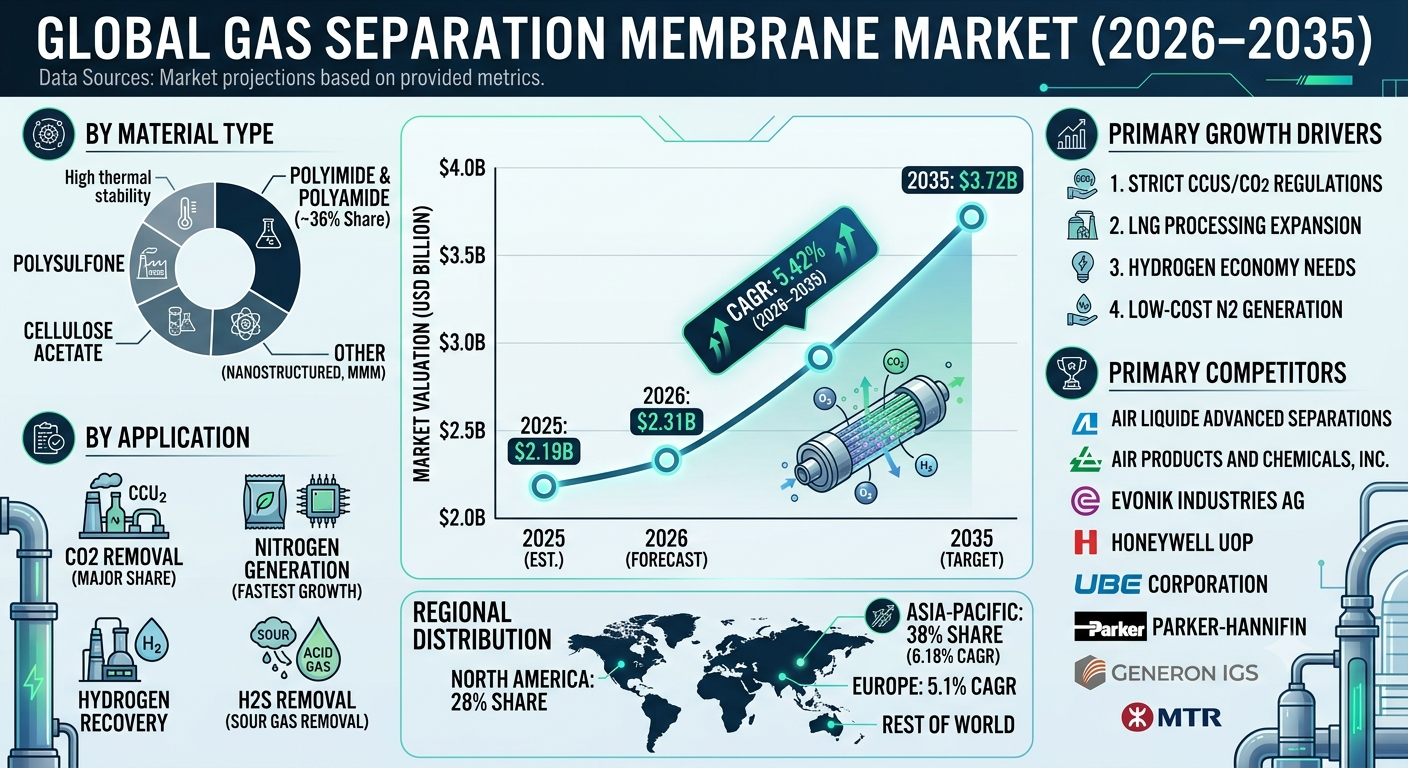
EUROPE, UNITED KINGDOM, August 25, 2026 /EINPresswire.com/ — The global gas separation membrane market is entering a decade of policy-backed expansion driven by the convergence of clean hydrogen ambitions, carbon capture mandates, and the relentless scaling of natural gas and liquefied natural gas infrastructure. Valued at an estimated $2.19 billion in 2025, the market is projected to grow from $2.31 billion in 2026 to approximately $3.72 billion by 2035, registering a compound annual growth rate of 5.42%. This trajectory is anchored by two powerful catalysts: the U.S. Department of Energy’s $1.2 billion Carbon Capture Demonstration Projects Program and the rapid scaling of global LNG infrastructure, which demands advanced membrane separation technology for gas purification systems at every stage of the value chain.
The Technology Shift: From Thermal Scrubbing to Polymeric Membranes
A meaningful technology shift is reshaping how processors approach selective gas separation. Traditional amine-based scrubbing and pressure swing adsorption units, long the workhorses of carbon dioxide separation and hydrogen purification, are steadily giving way to next-generation polymeric membranes and mixed-matrix membrane architectures. The International Energy Agency estimates that global hydrogen demand will surpass 115 million tonnes by 2030, creating enormous pull for membrane gas processing solutions that offer lower energy penalties and smaller physical footprints than legacy thermal methods. Investments in air separation membranes for on-site nitrogen generation systems have accelerated in parallel, driven by semiconductor and food packaging demand.
Membrane systems require 40 to 60% less footprint than amine scrubbers and avoid solvent degradation issues, making them ideal for space-constrained retrofits. Energy consumption is typically 20 to 30% lower because membranes eliminate the regeneration heat duty that drives amine operating costs. Commercial polymeric membranes deliver 95 to 99% hydrogen purity in single-stage configurations, with multi-stage designs reaching 99.9% plus. Purity targets above 99.99% typically require a membrane-pressure swing adsorption hybrid approach.
Market Size and Forecast Trajectory
Market Research Future’s market sizing combines bottom-up revenue modeling from manufacturer shipments, end-user procurement data, and top-down macroeconomic validation against International Energy Agency and Energy Information Administration energy infrastructure projections. Historical figures from 2021 through 2024 are derived from company filings and trade association data, while forecast values from 2026 through 2035 are computed using a calibrated compound annual growth rate of 5.42%, cross-checked against pipeline project databases and regional capital expenditure announcements for membrane separation technology deployments. The market has grown from $1.72 billion in 2021 and is expected to reach $2.57 billion by 2028 before climbing steadily toward the $3.72 billion endpoint in 2035.
Segment Analysis by Material Type
Polyimide and polyamide membranes hold the dominant position in the gas separation membrane market, capturing a combined share of approximately 36% in 2025. Their leadership reflects superior thermal stability and selectivity in hydrogen separation membrane applications, particularly in harsh refinery environments where hydrogen recovery and acid gas removal operate at elevated temperatures. Leading manufacturers including Air Liquide and Evonik have built their commercial membrane portfolios around polyimide chemistries, and ongoing research and development is focused on improving plasticization resistance to extend polymeric membranes’ service life in high-carbon-dioxide feed streams.
Polysulfone-based polymeric membranes accounted for approximately $460 million in 2025, serving broad industrial gas filtration needs across refining and chemical processing. Cellulose acetate membranes are expanding at a 4.8% compound annual growth rate, driven by cost-effective deployment in natural gas sweetening and carbon dioxide separation projects. This material retains a strong position in natural gas sweetening applications where its favorable carbon dioxide-to-methane selectivity and relatively low production cost make it the membrane of choice for midstream operators. The material’s growth trajectory is supported by expanding biogas upgrading demand in Europe, where carbon dioxide separation from raw biogas is the critical processing step in producing pipeline-quality biomethane.
Other material types, encompassing nanostructured membranes and emerging mixed-matrix architectures, captured roughly 9% of the market. These advanced materials promise to overcome the Robeson upper bound, the historical trade-off between permeability and selectivity in membrane separation technology, enabling performance gains of 50 to 200% over current commercial offerings. Commercialization timelines suggest meaningful revenue contribution beginning around 2029 to 2031.
Request Free Sample Copy: https://www.marketresearchfuture.com/sample_request/7193
Segment Analysis by Application
Nitrogen generation and oxygen enrichment represent the largest application segment in the gas separation membrane market, commanding approximately 32% share in 2025. This dominance reflects the critical role of nitrogen generation systems across semiconductor fabrication, pharmaceutical manufacturing, and modified-atmosphere packaging. On-site membrane-based nitrogen generators have displaced delivered liquid nitrogen in many facilities, offering 30 to 50% lower total cost of ownership and eliminating supply chain disruption risk. TSMC’s Arizona fab and Samsung’s Taylor, Texas facility together represent over $60 billion in capital investment, each requiring on-site air separation membranes capable of delivering 99.999% purity nitrogen.
Hydrogen recovery is the fastest-growing application segment, projected to expand at a 6.1% compound annual growth rate through 2035. This acceleration reflects the global push toward clean hydrogen economies and membrane gas processing. Refineries, ammonia plants, and methanol facilities generate hydrogen-rich purge and tail gas streams that membrane gas processing units can capture at purities exceeding 95%, routing recovered hydrogen back into process loops and reducing fresh hydrogen consumption by 15 to 25%. For both blue and green hydrogen pathways, effective and affordable membrane gas processing is necessary to meet the Department of Energy’s Hydrogen Shot initiative target of $1 per kilogram clean hydrogen by 2031. The two application niches for selective gas separation that are currently expanding the fastest are electrolyzer off-gas purification and steam methane reformer tail-gas recovery.
Carbon dioxide removal was valued at approximately $390 million in 2025, with adoption accelerating under carbon capture mandates. The U.S. Inflation Reduction Act’s enlarged 45Q tax credit, which currently offers $85 per tonne of geologically stored carbon dioxide, has triggered over 120 new carbon capture, utilization, and storage project announcements since 2022, many specifying membrane-based carbon dioxide separation as the capture technology. The Carbon Border Adjustment Mechanism is pushing membrane-based carbon capture, utilization, and storage technologies toward energy-intensive businesses in Europe.
Removal of hydrogen sulfide captured roughly 12% of market share, serving sour gas processing in the Middle East and the Permian Basin. Other applications including beverage carbonation and specialty gas production are growing at a 3.9% compound annual growth rate.
Regional Landscape: Asia-Pacific Dominates, All Regions Expand
Asia-Pacific commands the largest share of the global gas separation membrane market at approximately 38% of revenue in 2025, and it is also the fastest-growing region with a projected 6.18% compound annual growth rate. This dominance stems from China’s petrochemical buildout and India’s expanding refinery capacity. China alone captures roughly 42% of the regional share, with the 14th Five-Year Plan targeting 200 gigawatts of electrolysis capacity by 2035 and its massive coal-to-chemicals sector consuming substantial volumes of polymeric membranes for hydrogen recovery and carbon dioxide separation. India’s petroleum ministry has approved nine new refinery expansions totaling 1.5 million barrels per day of additional capacity, each requiring nitrogen generation systems and selective gas separation modules. India is expanding at a 6.8% compound annual growth rate, making it the standout growth market within the region. Japan contributed approximately $70 million, focused on hydrogen society strategy and ammonia co-firing applications. South Korea holds roughly 11% of the regional share through semiconductor nitrogen demand and hydrogen imports. The ASEAN bloc is expanding at a 6.2% compound annual growth rate through LNG regasification and industrial gas filtration.
North America holds the second-largest position with approximately 28% of global market share, generating roughly $610 million in 2025. The United States dominates the regional landscape with approximately 78% of North American revenue, benefiting from unmatched natural gas production and aggressive federal incentives for carbon capture. The 45Q tax credit expansion has triggered over 120 new carbon capture, utilization, and storage project announcements since 2022. U.S. dry gas output topped 103 billion cubic feet per day in 2023, and pipeline capacity additions in the Permian and Haynesville basins are expected to add another 12 billion cubic feet per day by 2027. Each new processing facility requires membrane separation technology for acid gas removal and dehydration. The U.S. alone approved six new LNG export terminals between 2022 and 2024, each incorporating gas purification systems with membrane modules. Canada is growing at a 5.6% compound annual growth rate through oil sands hydrogen recovery and LNG Canada exports. Mexico contributed approximately $30 million, with PEMEX refinery modernization and nitrogen generation demand.
Buy Now: https://www.marketresearchfuture.com/checkout?currency=one_user-USD&report_id=7193
Europe rounds out the top three regions, propelled by EU Green Deal mandates on carbon dioxide separation and decarbonization targets. Germany anchors the region with approximately 24% of European share, serving industrial decarbonization and hydrogen strategy implementation. The country’s National Hydrogen Strategy allocates EUR 9 billion through 2030 for hydrogen infrastructure, directly boosting demand for hydrogen separation membranes. The United Kingdom is growing at a 5.3% compound annual growth rate through North Sea carbon capture, utilization, and storage clusters and blue hydrogen development. France contributed approximately $40 million, supported by nuclear hydrogen coupling and biogas upgrading. Italy captures roughly 12% of the regional share through refinery conversion and ENI green refining. Spain is expanding at a 4.9% compound annual growth rate through renewable hydrogen corridors. The Nordic countries contributed approximately $30 million through green steel hydrogen and carbon capture, utilization, and storage infrastructure. Russia captured roughly 8% of regional share through natural gas processing and pipeline infrastructure. The rest of Europe is growing at a 4.7% compound annual growth rate through biogas-to-renewable natural gas projects across Eastern Europe.
South America was valued at approximately $150 million in 2025. Brazil dominates with roughly 62% of the regional share through Petrobras pre-salt gas processing operations, where high carbon dioxide content of up to 44% in reservoir gas makes membrane-based carbon dioxide separation the preferred technology. Argentina is growing at a 5.9% compound annual growth rate through Vaca Muerta shale development.
The Middle East and Africa generated approximately $180 million in 2025. Saudi Arabia leads with roughly 34% of regional share through Saudi Aramco sour gas projects and NEOM hydrogen development. The Jafurah unconventional gas program, an $110 billion development targeting 2 billion cubic feet per day by 2030, is one of the single largest demand catalysts for industrial gas filtration and membrane separation technology in the region. The NEOM green hydrogen project, designed to produce 600 tonnes per day of green hydrogen for export, will deploy hydrogen separation membranes at an unprecedented scale. The United Arab Emirates is growing at a 5.7% compound annual growth rate through ADNOC gas processing expansion, which has committed $15 billion to gas processing infrastructure. South Africa contributed approximately $10 million through Sasol gas-to-liquids operations. Egypt captures roughly 12% of the regional share through Zohr gas field processing.
Report Summary: https://www.marketresearchfuture.com/reports/gas-separation-membrane-market-7193
Competitive Landscape
The gas separation membrane market exhibits high concentration, with the top five players commanding an estimated 55 to 65% of global revenue. The Herfindahl-Hirschman Index is estimated at approximately 1,400 to 1,600, placing the market in the moderately concentrated range. Competition centers on membrane material innovation, system integration capabilities, and long-term service contracts for gas purification systems. Strategic partnerships between membrane manufacturers and engineering, procurement, and construction firms are increasingly common as end users demand turnkey selective gas separation solutions.
Air Liquide leads with an estimated 12 to 16% revenue share, offering MEDAL polyimide membranes and nitrogen generation systems through a vertically integrated gas-membrane-services model. In October 2024, the company partnered with industrial technology providers to deploy its advanced polyetheretherketone hollow-fiber membrane systems across European biomethane grid facilities, accelerating commercial-scale carbon dioxide and hydrogen separation.
Air Products captures roughly 10 to 14% of the market through PRISM membrane separators and hydrogen separation membranes, positioning itself as a hydrogen economy leader with global engineering, procurement, and construction reach.
Evonik Industries holds approximately 8 to 12% as a material science innovator with strong European presence, offering SEPURAN polymeric membranes and biogas upgrading systems. In March 2024, the company launched SEPURAN Green Biogas, a new hollow-fiber gas separation membrane module specifically optimized for small-scale and decentralized biogas upgrading plants to maximize methane recovery efficiency.
UBE Corporation captures roughly 6 to 9% with polyimide hollow-fiber membranes for industrial gas filtration, serving as a Japanese technology pioneer with Asia-Pacific distribution strength.
Honeywell UOP accounts for approximately 6 to 9% through membrane-solvent hybrid systems and carbon dioxide separation, specializing in refinery and petrochemical integration. In January 2025, the company established a strategic collaboration with midstream energy operators to supply its Separex membrane systems, integrating advanced polymer technology to optimize acid-gas removal and natural gas purification under high-pressure conditions.
Parker Hannifin holds roughly 4 to 7% with nitrogen and air separation membranes and original equipment manufacturer modules, leveraging broad industrial distribution and modular system design. Schlumberger captures approximately 3 to 6% through oilfield gas processing membranes and acid gas treatment, bringing upstream oil and gas application expertise. Fujifilm holds roughly 3 to 5% with thin-film composite membranes for selective gas separation, focusing on advanced materials research and development and emerging carbon capture, utilization, and storage applications.
Membrane Technology and Research captures approximately 2 to 4% with Polaris membranes for carbon capture and vapor recovery, operating as a niche innovator with strong Department of Energy research partnerships. DIC Corporation rounds out the competitive set with roughly 2 to 4% through hollow-fiber membrane modules and Asian market gas purification systems, leveraging cost-competitive Asian manufacturing.
Related Report
Waterproofing Membrane Market https://www.marketresearchfuture.com/reports/waterproofing-membrane-market-8506
membrane switch market https://www.marketresearchfuture.com/reports/membrane-switch-market-23617
roofing membrane market https://www.marketresearchfuture.com/reports/roofing-membrane-market-41596
Nanofiltration Membrane Market https://www.marketresearchfuture.com/reports/nanofiltration-membrane-market-12617
membrane bioreactor market https://www.marketresearchfuture.com/reports/membrane-bioreactor-market-25300
microfiltration membrane market https://www.marketresearchfuture.com/reports/microfiltration-membrane-market-33508
bitumen membrane sheets market https://www.marketresearchfuture.com/reports/bitumen-membrane-sheets-market-30914
Market Research Future
Market Research Future
+1 855-661-4441
email us here
Legal Disclaimer:
EIN Presswire provides this news content “as is” without warranty of any kind. We do not accept any responsibility or liability
for the accuracy, content, images, videos, licenses, completeness, legality, or reliability of the information contained in this
article. If you have any complaints or copyright issues related to this article, kindly contact the author above.

Media gallery