SHIRO & Co. Publishes Updated ‘The Supervisory Layer’ Observation With Formal HOLD State
The Kosuke Protocol observation examines how monitoring, authorization and execution suspension may apply to

Press Release Disclaimer: This is a press release distributed through the XPR Media network. It has not been independently verified by our newsroom.
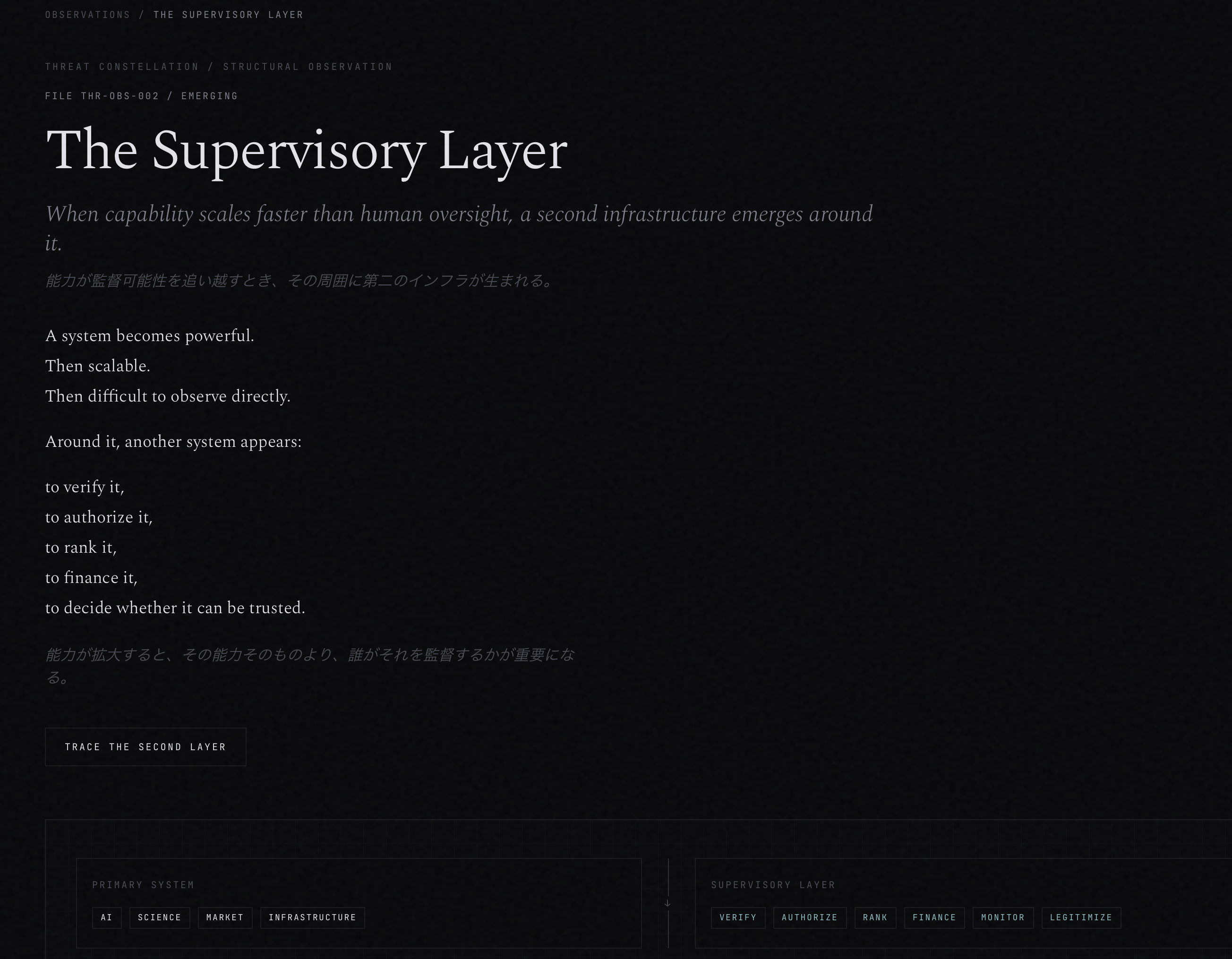

The Kosuke Protocol observation examines how monitoring, authorization and execution suspension may apply to increasingly autonomous AI systems.
TOKYO, OTA-KU, JAPAN, September 8, 2026 /EINPresswire.com/ — SHIRO & Co. has published an updated version of The Supervisory Layer, an observation generated through the Kosuke Protocol that examines how oversight may change as artificial intelligence systems become increasingly autonomous.
The updated observation introduces HOLD, a supervisory state designed to describe situations in which an autonomous action is neither approved nor rejected, but is prevented from proceeding until specified conditions are resolved.
SHIRO & Co. defines HOLD as:
“A formal supervisory state in which autonomous action is neither approved nor rejected, but deliberately prevented from proceeding until required conditions are resolved.”
The concept is presented as part of The Supervisory Layer, SHIRO & Co.’s observational framework for examining systems that verify, authorize, monitor, constrain and trace increasingly autonomous activity.
A THIRD SUPERVISORY STATE
The updated model distinguishes among three supervisory outcomes:
APPROVE / HOLD / REJECT
APPROVE permits an action to proceed.
REJECT determines that the requested action should not proceed.
HOLD leaves the decision open while execution remains suspended and unresolved conditions are addressed.
The observation also distinguishes HOLD from a technical pause. A system may enter a paused technical state following a HOLD decision, but SHIRO & Co. defines HOLD as a supervisory decision rather than an execution mechanism.
Conditions described in the model include unresolved identity, authorization, action scope, operating state, traceability, reversibility and escalation requirements.
RUNTIME SUPERVISION
The Supervisory Layer also examines the shift from monitoring individual AI outputs toward observing autonomous behavior over time.
The updated observation expresses this process as:
OBSERVE
→ EVALUATE
→ HOLD / ALLOW / STOP
Under this model, monitoring and intervention are treated as separate functions. Monitoring establishes visibility into an autonomous system’s activity, while supervisory decisions determine whether execution can continue.
The observation considers runtime behavior monitoring, agent identity, permission boundaries, interaction traces, action provenance and incident reconstruction as areas relevant to this form of supervision.
FROM SOFTWARE TO PHYSICAL SYSTEMS
The observation also considers how supervisory requirements may change when AI systems interact with physical equipment.
It references Anthropic’s limited research preview of the Model Hardware Standard as one current signal involving AI agents interacting with programmable scientific and manufacturing equipment.
The observation describes the progression as:
SOFTWARE TOOL ACCESS
→ HARDWARE COMMAND
→ PHYSICAL STATE CHANGE
SHIRO & Co. uses the term Physical Permission Boundary for the point at which a requested physical action is evaluated against conditions including identity, authorization, scope, limits, system state, reversibility and escalation.
In the updated model, that boundary can produce three outcomes:
ALLOW / HOLD / DENY
HOLD represents the case in which execution remains suspended while one or more supervisory conditions remain unresolved.
SOFTWARE, COLLECTIVE AND PHYSICAL AUTONOMY
The Supervisory Layer tracks three forms of autonomy across signals currently being observed by SHIRO & Co.:
SOFTWARE AUTONOMY
→ COLLECTIVE AUTONOMY
→ PHYSICAL AUTONOMY
SHIRO & Co. does not present this sequence as a universal lifecycle or industry standard. It is used as an observational model for examining how the consequences of autonomous action may change as AI systems move across software, multi-agent and physical environments.
AN OBSERVATION GENERATED THROUGH THE KOSUKE PROTOCOL
The Supervisory Layer was developed through the Kosuke Protocol, SHIRO & Co.’s method for connecting fragmented signals across technology, markets, institutions and human behavior into structured observations.
HOLD has been incorporated into the observation as a way of examining the period between authorization and final rejection when conditions remain unresolved.
The framework is exploratory. SHIRO & Co. does not describe HOLD as an existing industry standard, regulatory requirement or universal engineering specification.
The observation will continue to track developments in AI agent supervision, authorization, runtime monitoring, physical-system access and institutional oversight.
The broader research question remains:
Who supervises the supervisor?
ABOUT SHIRO & CO.
SHIRO & Co. is an independent research and design initiative studying structural change across technology, society, markets and human behavior. Its Kosuke Protocol organizes fragmented signals into observations, patterns and applied research questions.
KOSUKEMAIKO SHIRAKO
SHIRO & Co.
+81 80-1269-5473
email us here
Visit us on social media:
LinkedIn
Legal Disclaimer:
EIN Presswire provides this news content “as is” without warranty of any kind. We do not accept any responsibility or liability
for the accuracy, content, images, videos, licenses, completeness, legality, or reliability of the information contained in this
article. If you have any complaints or copyright issues related to this article, kindly contact the author above.

Media gallery